by Sam Shepard
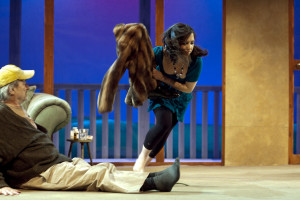 A quirky, often frightening family of antagonists in a claustrophobic farmhouse somewhere in the American Midwest
Buried Child is a macabre look at an American Midwestern family with a dark, terrible secret. The father stopped planting crops in his fields and took to smoking, drinking and watching TV. His wife, apparently seeking salvation, turned to religion. Her son went insane with guilt and grief, spent time in jail and only recently returned to the farm, perhaps to set everything right. With the arrival of the estranged grandson and his girlfriend, Shelly, the secret is drawn out into the light of day, and the family curse apparently lifted…
With its lower-class, sometimes humorous, recognizable characters and dialogue, Buried Child resembles the mid-century American realism and grotesquerie of Arthur Miller or Tennessee Williams. However, its roots in ritual and its approach to monumental, timeless themes of human suffering – incest, murder, deceit and rebirth – resemble the destruction wreaked by the heroes of Greek tragedy. The play contains many of Shepard’s favorite motifs: a quirky, often frightening family of antagonists in a claustrophobic farmhouse somewhere in the American Midwest.
“We don´t know each other in America. It starts on the family level, and there are certain areas in the country like in the west and in the south where `family´ is very strong, and there are other areas where it doesn´t even exist! People don´t have any connection whatsoever to each other, to their siblings, or know who their father is or their mother, they´re just wild.
I´m haunted by that character. The American character is more about that than anything else, more than success, more than power and strength and all the other things that we present ourselves to be. It´s more about the strange, strange lack of identity. We don´t really know who we are, we never have known who we are. We’ve invented it! We don´t have a clue! We´re like wandering vagabonds!” Sam Shepard
Sam Shepard is one of America’s most prolific playwrights and actors of our time. Famous for his acting roles in such movies as The Right Stuff, Homo Faber, Black Hawk Down and The Assassination of Jesse James, he made a name for himself very early as a writer of plays such as True West and Fool for Love. For Buried Child he was awarded the Pulitzer Prize for Best Drama in 1979. He also wrote numerous movie scripts, two of them for German director Wim Wenders (Paris Texas and Don´t Come Knocking). In his plays Shepard dissects the rituals, the vernacular and the moral codes of the American lower class with a crude mixture of action, sarcastic humour and bone-dry realism.
Veronika Nowag-Jones has directed numerous plays by Brecht, Tabori, Shepard, Euripides and others for theatres in Berlin, New York City (NY), Louisville (KY), Philadelphia (PA), and Atlanta (GA).
English Theatre Berlin presents Buried Child as a Germany premiere in collaboration wth 7 Stages Theatre Atlanta.
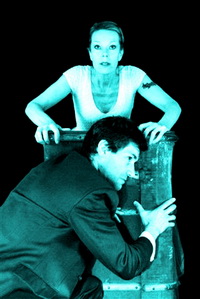 Peter Oswald´s short plays represent a re-discovery of the complexity of the human spirit in all its manifestations of comedy, tragedy, farce, surrealism, the grotesque and the very real.
 (Lights up on a man.)
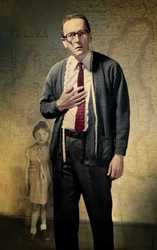 A story of journeys, of how a boy who grew up on a farm in Galicia, Poland, came to be a tailor in Inverness. His life spanned most of the 20th century. His story is not straightforward.
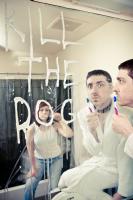 Make your own blockbuster, or come and watch Kevin and Amber make one right in front of you.
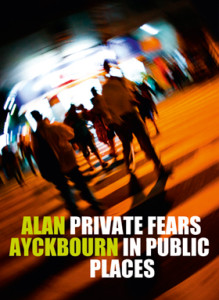 Six people in a big city. All of them are in search of a home, a niche or a relationship.
 In fifty-four scenes – some of them just short clips – Alan Ayckbourn masterfully creates an atmosphere of exquisite melancholy and grotesque failure. His sympathetic view of the characters keeps schadenfreude and black humour at bay and instead makes us grin at the all-too-familiar situations from our own lives. With a keen humane eye, Ayckbourn finds a universal language for the impossible dream of fulfilled desires.
 (Girl) I want hold him
 Oh, I know yours isn’t – but I bet you know of someone’s who’s is!
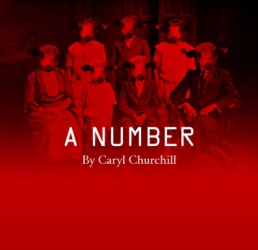 “Walk round the corner and see yourself you could get a heart attack. Because if that´s me over there who am I?”
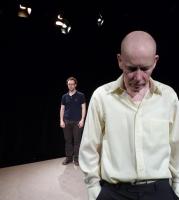 Caryl Churchill’s compelling thought-experiment has a single, simple premise: humans have been cloned. In one hour of ferociously intense tragicomedy, she digs down to the roots of personal identity, exposing the hard but brittle bond between fathers and sons and the ultimate cost of evasion. The past can be buried, but it won’t stay down.