Staged Reading and Panel Discussion
Israeli dramatist Hanoch Levin and his translations into German – staged reading, panel discussion and book launch: Die im Dunkeln gehen
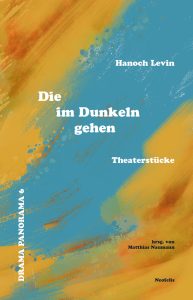
Hanoch Levin (1943–1999) was the most important Israeli dramatist of the 20th century, whose work left important artistic and socio-political marks on the Israeli theater. Today, his plays are part of the canon in Israel and are frequently produced. Levin is also well known and performed in other countries, especially France and Poland, while many of his plays remain yet to be discovered in Germany.
Translations and productions must help to make this happen. Matthias Naumann published the first German monograph on Levin (Dramaturgie der Drohung. Das Theater des israelischen Dramatikers und Regisseurs Hanoch Levin. Marburg: Tectum 2006) and initiated the first German-language productions with his translations of Levin’s plays. Now six of Levin’s plays will appear for the first time in German translation in the anthology Die im Dunkeln gehen (Berlin: Neofelis Verlag 2022).
Israeli theater studies scholar Freddie Rokem and translator Matthias Naumann will present the new book Die im Dunkeln gehen and together with Barbora Schnelle (who will moderate the discussion) and director Antje Thoms, who directed the first German-language production of Levin’s Das Kind träumt in Augsburg in 2018, will discuss which of Levin’s plays are interesting for German-language stages and audiences, along with which challenges they pose to translations and productions.
In a staged reading, we will present excerpts from Das Kind träumt and other plays from the book Hanoch Levin: Die im Dunkeln. Levin’s best-known play, Das Kind träumt, draws on historical experiences of persecution and tells the story of a mother and her child’s flight from soldiers to the land of dead children, where the Messiah is supposed to appear. Die Kofferpacker, in contrast, is a comedy that draws the lives of several families in a flurry of short scenes between departures, returns and unfulfilled dreams, and between weddings and funerals.
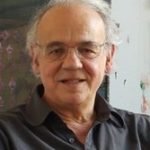 Freddie Rokem is Professor Emeritus at the Department of Theater at Tel Aviv University, where he was Dean of the Faculty of the Arts (2002–2006) and held the Emanuel Herzikowitz Chair for the Arts of the 19th and 20th Centuries (2006–2016). He has been a guest professor at various universities, such as the Freie Universität Berlin, the Goethe-Universität Frankfurt am Main and the University of Chicago. The following of his books have been published in German translation: Geschichte aufführen. Darstellungen der Vergangenheit im Gegenwartstheater (2012) and TheaterDenken. Begegnungen und Konstellationen zwischen Philosophen und Theatermachern (2017). Rokem also works as a dramaturg and translator.
 Antje Thoms studied applied theater studies in in Gießen and was then an assistant director at the Niedersächsisches Staatstheater Hannover. There she worked with directors including Sebastian Nübling, Luk Perceval and Jossi Wieler. Since 2003, she has worked as a freelance director and writer, and in 2007 founded the independent Zürcher Theaterformation Trainingslager with the writer Jens Nielsen and actor Dominique Müller. From 2014/15 to 2021/22, Antje Thoms was house director at the Theater Göttingen and starting in the 2022/23 season is director of drama at the Theater Regensburg.
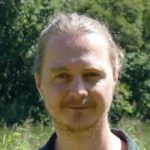
Matthias Naumann is a writer, translator and publisher. Since 2011, he has been the director of Neofelis Verlag, Berlin, which published the series Drama Panorama – Neue internationale Theatertexte. His plays have been invited to the Autorentheatertagen and to the Heidelberger Stückemarkt, since 2014 he has mainly worked as part of the collaborative theater group Futur II Konjunktiv. He also translates plays from Hebrew.
We are very pleased to partner with Drama Panorama to host this event. Please click HERE to read the complete event information on their website.
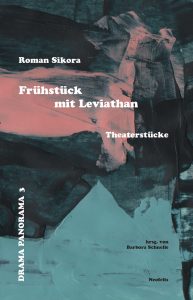
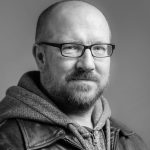 After completing his training, Roman Sikora worked as an electrician and mechanic at the steelworks in his hometown of Třinec, before he studied directing and dramaturgy at the Janáček Academy for Music and the Performaing Arts in Brno. Today he works as a freelance playwright and theater critic, translates from Polish (e.g. Małgorzata Sikorska-Miszczuk) and teaches playwriting at the faculty of theater at the the Academy of Musical Arts in Prague. Sikora’s plays have been translated into many languages and performed internationally.
 Barbora Schnelle works as a freelance translator, theater critic and culture manager. In 2009, with Antje Oegel, she founded the project Drama Panorama: Forum für Übersetzung und Theater. In 2014 she founded the festival of contemporary Czech theater Ein Stück: Tschechien in Berlin, which she has run and curated since then.
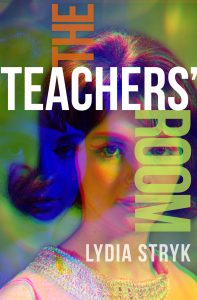 dwest town, two teachers set eyes on each other and find it hard to look away.
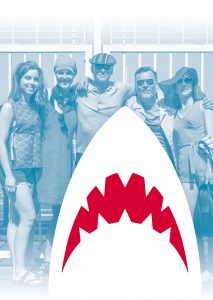 Jaws / Der Weisse Hai captures the aura of a turning point in history – the mid 1970s – and transforms the film’s images, its music, its evocative qualities into a long overdue conversation with a cultural icon. By examining the (then) critical content and (dwindling) relevance of Steven Spielberg’s 1975 movie Jaws we’re dancing and performing an entertaining and critical new look at this mega blockbuster (in fact, the first one of the so called “blockbuster era” of Hollywood movies).
 Spielberg’s Jaws is a striking example of a cultural turning point: Just when the so-called counterculture seemed to finally dominate, preparations for a new era began. The names Thatcher, Reagan and Kohl and the economic terms neoliberalism, deregulation and privatization brought traditional values back to the fore and countered the ideas of counterculture. After ten years of youthful optimism, but also mistrust, defeat and fear – Nixon and Watergate; defeat in the Vietnam War, the oil crisis and economic decline – Jaws showed a society banding together in the face of a grave threat, recalling its old values and again producing heroes from its midst.