“All the lonely people, where do they all come from? All the lonely people, where do they all belong?” – The Beatles
Today we are living in the age of systemic loneliness. Despite the world being more interconnected and globalized than ever before, the number of lonely people continues to grow. Even before the pandemic started, loneliness was already a widespread problem: according to studies, one in ten people living in Germany felt lonely frequently or all the time. The pandemic has only made it worse. Social media, technology, capitalism, hedonistic consumer culture, neoliberal work ethics and urban way of living are contributing to the rise in loneliness and benefiting from it at the same time. Together they form a system that exposes us to loneliness on a daily basis and on a global scale. It not only affects our personal well-being, but also undermines our sense of collective belonging.
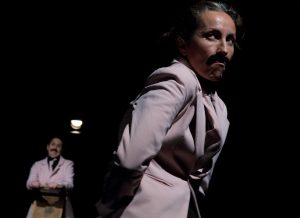
The Intervention of Loneliness is a collaborative dance performance that looks at the issue of systemic loneliness and human disconnection. Developed from an earlier public intervention (Dance With Me) – in which Ming Poon traveled to different cities asking strangers on the street to slow dance with him – this performance invites us to confront systemic loneliness together onstage. Slow dancing becomes an act of resistance, as our bodies reach out, make contact and hold each other. How can we reclaim loneliness, rather than letting it own us? What has the pandemic taught us about it? How can we transform loneliness from a place of separation and isolation into a tool for collective action and solidarity?
Note: A post-performance discussion will be offered after every show.
Ming Poon is a Berlin-based choreographer who began his career as professional dancer in 1993 and started to develop his choreographic practice in 2010. He works with applied choreography and creates choreographic interventions, where spectators are invited to exercise their agency to create change. His works are interactive and collaborative in design. They usually take the form of collaborative performances, public interventions and one-to-one encounters, and involve vulnerability, care, peripherality, queerness and failure as performance strategies. His practice is influenced by Buddhist concept of interdependence and care, Judith Butler’s resistance in vulnerability, Augusto Boal’s theater of the oppressed and Nicolas Bourriaud’s micro-utopias.
He initiated Asian Performing Artists Lab (APAL) in 2020 and is a founding member of United Networks gUG, a non-profit organisation for marginalized BIPoC artists in Germany. He is currently a fellow in the Berlin Artistic Research Program (2022-2023).
His works have been presented at Esplanade – Theatres on the Bay (Singapore), The Substation (Singapore), English Theatre Berlin | International Performing Arts Center (Berlin, Germany), Hebbel am Ufer (Berlin, Germany), Scenario Pubblico | Centro Nazionale di Produzione della Danza (Catania, Italy) and Südpol (Luzern, Switzerland).
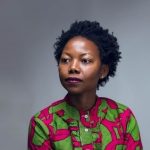 NoViolet Bulawayo is the author of the novels Glory and We Need New Names, which was recognized with the Hurston/Wright Legacy Award, the Pen/Hemingway Award, the LA Times Book Prize Art Seidenbaum Award for First Fiction, the Etisalat Prize for Literature, the Fred Brown Literary Award, the Betty Trask Award, the Barnes and Noble Discover Award (second place) and the National Book Foundation “5 Under 35” Fiction Selection. We Need New Names was also shortlisted for the International Literature Award, the Man Booker Prize, and the Guardian First Book Award. NoViolet earned her MFA at Cornell University where she was a recipient of the Truman Capote Fellowship. She has taught fiction writing at Cornell and Stanford Universities. She grew up in Bulawayo, Zimbabwe, and is currently writing full-time from the wherevers.
 Since October 2022, Anne Potjans has been a postdoctoral researcher in the EU-funded research project Tales of the Diasporic Ordinary. Aesthetics, Affects, Archives at Humboldt-Universität zu Berlin, where she currently investigates the relationship between queer subcultural spaces and discourses on race and racism in Germany and the United States. Earlier in 2022, she completed her doctoral degree with a dissertation on “‘Why Are You So Angry?’” – The Uses of Rage and Anger in Black Feminist Literature” in the American Studies program at Humboldt and is a joint winner of Peter Lang’s competition New Perspectives in Black Studies, for which she received a publishing contract with Peter Lang in 2021. Apart from that, she has worked on diasporic connections between African American and Black German feminist autobiographical writing in the post-World War II period and the intersections of Blackness, sexuality, and racial visibility in German film productions. She was an exchange faculty in the Honors program at the University of Washington in the fall of 2019 and has presented and published her research both nationally and internationally.

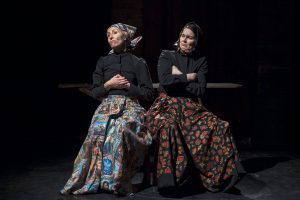 Everywhere they look things are not equal; in the taxi at the end of the night, on the bench in the middle of a village, in the congregation, in the boardroom, in the home. They tell stories of abortion, sing about violence and dance about menopause. They remember the lies they were told as children and question the hope that things might be different for future generations.