by John Clancy
 (Lights up on a man.)
A man stands in a pool of light in front of a room of suddenly silent strangers.
Stop me if you’ve heard this one before.
(Pause.)
They watch him, waiting to hear what he will say next.
Seriously. Stop me.
The highlight of The Edinburgh Festival Fringe 2009 and the Adelaide Festival 2010: Adelaide Fringe Award Best Performer 2010 for David Calvitto (also Edinburgh Fringe Festival Stage Best Actor 2002 for Horse Country and Audience Favorite Award for 12 Angry Men at the 2003 Edinburgh Festival)
What if everything we believe and experience is an illusion-a fantasy designed to make us forget all that’s important and create a kind of collective amnesia? Are we all alone on our own private stages? Is there anything out there in the darkness? Are we who we say we are, or are we just pretending?
A deceptively simple piece of theatre, which playfully but profoundly leads us to question, not only the nature of reality, but the very nature of existence itself. A man standing in a pool of light wittily deconstructs the theatrical experience while offering parallel insight into modern life.
“An intelligent and exhilarating monologue, performed with a conjurer’s elan by David Calvitto …. he stands on stage and deconstructs everything he is doing – the entire theatre-going experience. It’s funny and cute, but just when you think you’ve got the joke, the monologue lurches into darker, more invigorating territory, and you start to realise that the show is deadly serious. … The Event is a wake-up call to anyone who has ever wondered why it is that we know all the details of Jordan and Pete’s marriage breakup, but can’t say how many Iraqis have died in the Iraq war. It deliberately and cruelly destroys illusion: it makes us see how the trick is done, and challenges us to rise from our safe seats in the comforting dark and protest.” The Guardian
“American David Calvitto performs John Clancy’s monologue with aplomb. He’s a mix of droll Woody Allen and charming Steve Martin in a nice suit. The play probably won’t send us protesting into the streets but its beautifully written and does make you think. How do we know what’s real and what’s not? It’s great fun and, in the hands of Calvitto, highly entertaining.” Adelaide Advertiser
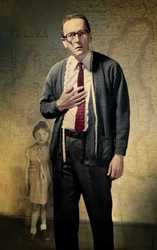 A story of journeys, of how a boy who grew up on a farm in Galicia, Poland, came to be a tailor in Inverness. His life spanned most of the 20th century. His story is not straightforward.
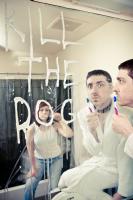 Make your own blockbuster, or come and watch Kevin and Amber make one right in front of you.
 (Girl) I want hold him
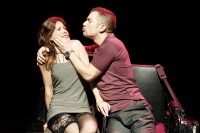 Oh, I know yours isn’t – but I bet you know of someone’s who’s is!
 Hip Hop meets theatre
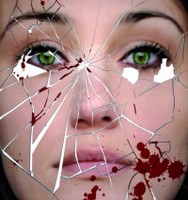 Having come home to visit her mother who has been placed in a nursing home, Diane, now a well-known writer, is being interviewed for the local newspaper. Her remarks are an answer to questions such as where she gets the ideas for her stories, whether her youth in Mountain Grove influenced her work and why she decided to leave home. At first obliging and matter-of-fact, Diane gradually reveals more than her interviewer might have bargained for a childhood marred by the loss of her father and her mother´s coldness; the promiscuity which she was driven to in search of the love and concern which were denied her at home; and, most devastating of all, the molestation by her stepfather which shaped her character indelibly – and led to the harrowing event which she describes at the end.
 War meets art in this intimate parable. A painter immerses herself in the creation of a real experience with the perfect image. But in K., a Middle Eastern city, the real images outshine and overshadow everything. She is shaken by the experiences of the effects of war, violence and poverty, impossible to depict. Now, forced to confront her lifelong beliefs in the value of art, she also questions how to deal with her position in the world today.
 An Iraqi immigrant tells his story. His name is Sad. He lives here illegally. At night he walks our streets and sells roses. He loves to speak our language but nobody listens. Will you?