etb English
Theatre
Berlin
International Performing Arts Center


Blog Archive

Bei mir bist du Strange

English Theatre Berlin’s first ever 10-minute play competition was on the theme ENGLISH IN DAILY GERMAN LIFE:

You can hardly overestimate the influence the English language has in German life today: in public spaces, on the street, over the internet and on TV.

But – what influence does English have on the way we live our daily lives? How can Grandma Erna possibly understand what she see in shop windows? Does Coffee To Go really come from Togo? And what about the confusion native English speakers experience when they see words used that apparently are English but which make absolutely no sense to them?

The winners:

WIRECENTER

In Other Words by Joshua Crone

The Exam by Joshua S. Horowitz

Ten Minutes with Günther by Sonny Hayes

Bombay an der Spree by Kevin McAleer

Hooray for Hollywood by Rich Rubin

Photo: Doris Spiekermann-Klaas/DerTagesspiegel

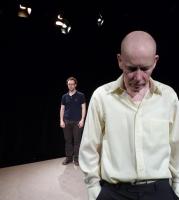
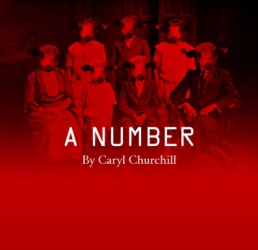
A Number

by Caryl Churchill

a-number-rot“Walk round the corner and see yourself you could get a heart attack. Because if that´s me over there who am I?”

A man uses his money to commission a clone: his contractors seize their chance to create twenty more. The talk is of paternal love, and of science, and of good intentions. But who will have to live with the consequences? And who will have to die?

“A taut, chilling two-man work about a desperate father who seeks to duplicate his lost son” – “enormously powerful” – “outstandingly well acted and staged” – “real and truthful in every moment” – “a maelstrom of deep, dark emotions laced with subtle sarcasm and ending with a hint of hope” – “an absolute must-see” – “Science&Theatre, a successful coproduction” (from the reviews in ExBerliner, Die Zeit Online, Neues Deutschland)

anumber-homepageCaryl Churchill’s compelling thought-experiment has a single, simple premise: humans have been cloned. In one hour of ferociously intense tragicomedy, she digs down to the roots of personal identity, exposing the hard but brittle bond between fathers and sons and the ultimate cost of evasion. The past can be buried, but it won’t stay down.


A Number was the first production in English Theatre Berlin´s  Science & Theatre program.

Supported by

fu_logo_150


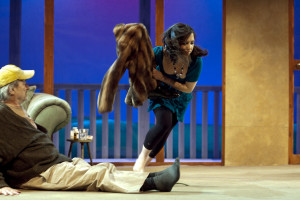
Buried Child

by Sam Shepard

Sam Shepards " Buried Child " im F40, english theatre berlin, Premiere 15. April 2010.A quirky, often frightening family of antagonists in a claustrophobic farmhouse somewhere in the American Midwest

Buried Child is a macabre look at an American Midwestern family with a dark, terrible secret. The father stopped planting crops in his fields and took to smoking, drinking and watching TV. His wife, apparently seeking salvation, turned to religion. Her son went insane with guilt and grief, spent time in jail and only recently returned to the farm, perhaps to set everything right. With the arrival of the estranged grandson and his girlfriend, Shelly, the secret is drawn out into the light of day, and the family curse apparently lifted…

With its lower-class, sometimes humorous, recognizable characters and dialogue, Buried Child resembles the mid-century American realism and grotesquerie of Arthur Miller or Tennessee Williams. However, its roots in ritual and its approach to monumental, timeless themes of human suffering – incest, murder, deceit and rebirth – resemble the destruction wreaked by the heroes of Greek tragedy. The play contains many of Shepard’s favorite motifs: a quirky, often frightening family of antagonists in a claustrophobic farmhouse somewhere in the American Midwest.

“We don´t know each other in America. It starts on the family level, and there are certain areas in the country like in the west and in the south where `family´ is very strong, and there are other areas where it doesn´t even exist! People don´t have any connection whatsoever to each other, to their siblings, or know who their father is or their mother, they´re just wild.

I´m haunted by that character. The American character is more about that than anything else, more than success, more than power and strength and all the other things that we present ourselves to be. It´s more about the strange, strange lack of identity. We don´t really know who we are, we never have known who we are. We’ve invented it! We don´t have a clue! We´re like wandering vagabonds!” Sam Shepard

Sam Shepard is one of America’s most prolific playwrights and actors of our time. Famous for his acting roles in such movies as The Right Stuff, Homo Faber, Black Hawk Down and The Assassination of Jesse James, he made a name for himself very early as a writer of plays such as True West and Fool for Love. For Buried Child he was awarded the Pulitzer Prize for Best Drama in 1979. He also wrote numerous movie scripts, two of them for German director Wim Wenders (Paris Texas and Don´t Come Knocking). In his plays Shepard dissects the rituals, the vernacular and the moral codes of the American lower class with a crude mixture of action, sarcastic humour and bone-dry realism.

Veronika Nowag-Jones has directed numerous plays by Brecht, Tabori, Shepard, Euripides and others for theatres in Berlin, New York City (NY), Louisville (KY), Philadelphia (PA), and Atlanta (GA).

English Theatre Berlin presents Buried Child as a Germany premiere in collaboration wth 7 Stages Theatre Atlanta.

Fallen Angels

by Noel Coward

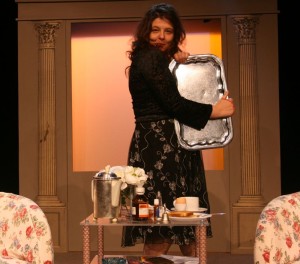
FallenAngels_EnglishTheatreBerlin_FotoAnyaKinneavy_webDesperate Housewives in London

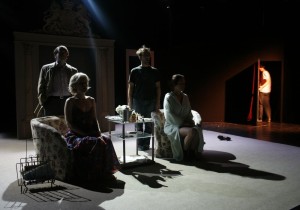
Julia and Jane, the fallen angels, are youngish married women, best friends, bored with their husbands and eager to reclaim their lost youth in the shape of a young Frenchman – with very little knowledge of English but considerable skills in the wooing department! – who had an affair with both of them before marriage. He sends a postcard to both women saying he is coming to London. They work themselves up into a drunken state of excitement in anticipation of their long-lost lover’s return…

Fallen Angels is one of Coward’s earliest plays: written in 1923, premiered in 1925, revived in 1949 and produced in America in 1955. In 1958 Coward returned to the play, re-writing and updating the set to 1934. The play’s scenario was, according to some reports, based on a real life episode when Coward and Gladys Calthrop were both dressed up waiting for a mutual boyfriend to arrive. (It is knowledge that Coward was homosexual).

Fallen Angels - Gruppe_web

The play was nearly refused its licence as “brightly written, but extremely dubious” and because “the women’s obvious willingness to go wrong, and about their pre-nuptial going wrong, would cause too great a scandal”. But the Lord Chamberlain, official censor of theatrical performances, passed it, with only a few dialogue changes, because he saw it as “so much unreal farcical comedy” – but nevertheless, Fallen Angels caused a lot of moral outrage when it was premiered in 1925.

Klaus Chatten studied acting at the Max Reinhardt-Seminar in Vienna and at the Actor´s Studio in New York. He worked as an actor at Maxim-Gorki-Theater, Theater am Kudamm, Schiller Theater, a. o. Since 1992 he has directed numerous productions for Freie Volksbühne, Kampnagelfabrik Hamburg, a. o. He wrote the script for Dani Levy’s 1996 movie Stille Nacht? Ein Fest der Liebe. His own plays include Klassentreffen and Sugar Dollies which opened 1996 at the Gate Theatre, London. Chatten has translated nine of Coward´s plays for gallissas publishing company.
Photos: Anya Kinneavy

Three Tall Women

by Edward Albee

As an imperious, acerbic old woman lies dying, she is tended by two other women – her middle-aged, sympathetic caretaker, and a brashly confident 25-year-old from her lawyer’s office who has come to discuss finances. She is visited by a young man.

Albee´s frank dialogue about everything from incontinence to infidelity portrays aging without sentimentality. His scenes are charged with wit, pain, and laughter, and his observations tell us about forgiveness, reconciliation, and our own fates. But it is his probing portrait of the three women that reveals Albee´s genius. Separate characters on stage in the first act, yet actually the same `everywoman´ at different ages in the second act, those “tall women” lay bare the truths of our lives ­ how we live, how we love, what we settle for, and how we die.
Image

A truly moving work with an undeniable affecting emotional core. It sparkles with Albee´s trademark: absurdist humour with a passionate emotional core. Three Tall Women is his finest work since Who´s Afraid of Virginia Woolf?.

Three Tall Women is an all-women´s project and involves – both as cast and crew – ten international female theatre makers living in Berlin.

Edward Albee has admitted in interviews that this play was directly inspired by his own adoptive mother, a domineering, Amazonian woman who, like the character in the play was prone to great hatreds and paranoia. One can¹t help but admire her, though, for her extraordinary self-confidence and stamina. Her presence reinforces a theme which continues to run through all of Albee´s works: life can only be defined by the inescapable proximity of death.

Three Tall Women first premiered at Vienna´s English Theatre on June 14, 1991. It won the Pulitzer Prize for Drama in 1994.

The Extremists

by CJ Hopkins

Spin or fact? Theater or reality? A biting, original political satire that challenges audiences of any political affiliation, The Extremists is a labyrinth of wordplay and mind games in which a television talk show host and his guest who wrote a book about terrorism get lost in their own doublespeak … or are they really double-agents, subversively reprogramming our sound-byte-saturated minds?

This is a funny and fast-paced work of fiction, not an extract pulled from today’s headlines or news shows … but really, what’s the difference anymore? What does it say about the state of democracy, when Image the majority of citizens in the most powerful democratic country in the
world can be led to war by nothing more than sophisticated marketing tactics? How free are we really? Are we thinking critically? How could we be, having been subjected to non-stop media manipulation from the time we were born?

The word `insane´ is one of the most frequently heard words on the stage … It describes the evening very well. … The Extremists begins as harmless media satire, a conversation in which the host and the invited expert toss empty phrases back and forth … Hopkins builds a construct of ideas out of their rhetoric, until everything revolves around one thing: What is the truth for the good guys, and what is it for the bad guys? … What is the reality? … Intellectual theater in the truest sense. Tagesspiegel / 17 Feb 2009

CJ Hopkins’ writing for the stage has been an exploration of the manipulative power of language and mimesis. In his award-winning plays, Horse Country and Screwmachien/Eyecandy, he fuses traditional dramaturgy with linguistic and performative strategies borrowed from other discourses, such as marketing tactics, political speeches, psychological conditioning, hypnotic suggestion- while at the same time, he lays bare the machinery of those discourses.
In The Extremists, as in his earlier plays, Hopkins’ main subject is authoritarianism, both externalised in society and internalised within our unconscious minds.
Humor and wordplay keep the work entertaining. However, Hopkins’ real artistic goal is to create a state where we are forced to question the nature of the event unfolding before us, and the power that event is exerting on us, believing that,
in this state of radical uncertainty, off balance and questioning, we become more awake, more aware of our own conditioning and programming, and thus, hopefully, more able to change it.

CJ Hopkins began writing for the stage in 1987. In 1994 he was awarded a Drama League of New York Developing Artist fellowship, and, in 1995, a development residency at Mabou Mines. The premiere of his first full-length play, Horse Country, was presented at HERE Arts Center in New York City in 1997. Since then, Hopkins’ works, including A Place Like This, The Installation, How to Entertain the Rich, The Position, Cunnilinguistics, Texas Radio, and various experimental texts, have been produced regularly in New York, and in Los Angeles, Philadelphia, and Chicago, among other US cities.

In 2002 Horse Country  won the most prestigious writing award of the Edinburgh festival fringe, the Scotsman ‘First of the Fringe Firsts.’ Since then, Horse Country has toured and been produced internationally, playing theatres and festivals including London, Edinburgh, Sydney, The Du Maurier World Stage Festival in Toronto, the Brighton Festival, and the Noorderzon Festival in Holland. In 2004 it again won a ‘Best of the Fringe’ award, this time at the Adelaide Fringe Festival.

In 2005, the world premiere of Screwmachine/Eyecandy, or: How I learned to Stop Worrying and Love Big Bob was presented at the Edinburgh Festival Fringe, where it won a Scotsman ‘Fringe First’. The New York premiere was presented at 59E59 Theaters in the Spring of 2006.

Since 2004, Hopkins has been based in Berlin, Germany, where, in 2006, he was commissioned to write and direct a site-specific play, Der Aufstand, for the Freie Universität Berlin. In 2007, Hopkins was commissioned by the Technische Fachhochschule Wildau, in Brandenburg, to create a site-specific multimedia piece, Nur Gerede, keine Taten, which was presented at the University in October.

Although based in Europe, Hopkins maintains close ties to New York, where he is associated with Clancy Productions, and with director John Clancy, with whom he has collaborated on several productions since 1999.

Walter D. Asmus

is a well-known German theater director who worked with Samuel Beckett on many occasions for the stage and television, from the time they first met at the Schiller-Theater in Berlin in 1974. He became his assistant director on their famous production of Waiting for Godot. He has directed all of Beckett’s plays internationally including Waiting for Godot at the Brooklyn Academy of Music, New York in 1978 and the Gate Theatre, Dublin in 1988. His television work includes Footfalls, Rockaby and Eh Joe with Billie Whitelaw, and a French version of Waiting for Godot with Roman Polanski as Lucky.

He was co-organizer and Artistic Director of the international festival, `Beckett in Berlin 2000´. In 2000/2001 he directed the filming of Footfalls with Susan FitzGerald for the `Beckett on Film´ project in Dublin. In 2004 he directed Waiting for Godot at 7 Stages, Atlanta and for the Rubicon Theatre in Ventura, California. In 2005, he directed the first Chinese production of Endgame in Mandarinin Shanghai, China. Recently, he directed a stage adaptation of Beckett’s novella First Love forthe Writer’s Festival in Sydney. Walter D. Asmus was a friend of Beckett’s until the writer’s death in 1989.

Del Hamilton

As co-founder of 7 Stages, Del Hamilton has been a part of the company since its inception in 1979. As Artistic Director, he has directed over 60 productions at 7 Stages, including numerous plays by Sam Shepard and, most recently, The Little Prince by Antoine de Saint Exupery and Who´s Afraid of Virginai Woolf? by Edward Albee. He has also acted in numerous plays. Del directed a very successful production of One Flew Over the Cuckoo´s Nest at Teatr Nowy in Poznan, Poland, and he has acted and directed at many notable theaters in Atlanta, New York, London, Paris, Belgrade, Johannesburg and Amsterdam. Del is the author of several plays and has received numerous awards.

Tim Habeger

Co-Founder and Artistic Director of PushPush Theater, is a director and writer for film and theater.
In New York City, he worked with Ellen Stewart at La Mama ETC, was in the company at The Neighborhood Group Theater and served as artistic director of Bridge Arts. He worked at 7 Stages Theater in Atlanta where, among other tasks, he was Joseph Chaikin’s assistant, and he helped coordinate artistic workshops in coordination with a Rockefeller Foundation sponsored New Play Project, and a US/Netherlands multi-year touring program.
He completed was certified in dance and drama in New York’s Artist-in-Residence program and taught for film for three years at AMDA.
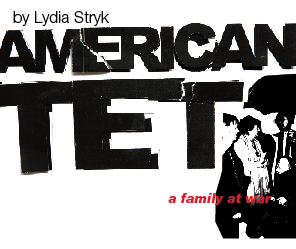
American Tet

by Lydia Stryk

american_tet_ohneAn army family at war …

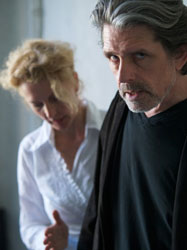
American Tet enters into the lives and world of a military family, the Krombachers. The father, Jim, served in Vietnam before building a career in the Army; while the son, Danny, currently serves as a military policeman in Iraq. And then there is Elaine, an exemplary military wife and mother – an upright patriot who teaches the spouses of new soldiers the ins and outs of military life.

The family, including the rebellious daughter, Amy, await Danny who is coming home on leave. Danny’s return brings unexpected complications into the black and white world of duty and pride. Coming home, too, is Danny’s friend, Angela, who has been gravely injured in the war. Meanwhile, Elaine encounters a woman from another world, Nhu, – from Vietnam – who unsettles her and sets about the unraveling of her unquestioned assumptions and world.

American Tet is a brutal account of the effect of the current war in Iraq and past wars, on soldiers and soldiers’ families. What´s important? Who is right? How does terror begin and most of all ­ why?

“It’s not a pretty play. But it’s not a pretty world.” Lydia Stryk

“Ein ziemlich beeindruckendes Stück…, das sich keine wohlfeile Moral leistet oder seine Figuren denunziert. (Es) liefert vielmehr eine sehr authentische Zustandsbeschreibung jenes tief verunsicherten US-Amerika, das sich nun Barack Obama zum Präsidenten wählte…” TAZ (Esther Slevogt)

Lydia Stryk
born in DeKalb, Illinois, trained to be an actress at the Drama Centre, London, later studied history, education and journalism. She has a BA in History from Hunter College, an MA in Journalism from NYU and a Ph.D. in Theatre from the Graduate Centre of the City University of New York.
She is the author of fifteen full-length plays and a few short ones. Her work has been anthologized in America and published and translated into German by Per Lauke Verlag, Hamburg. Her plays have been seen at festivals around the United States and in Europe and produced at many theatres throughout the US, and in Germany at Schauspiel Essen and Theaterhaus Stuttgart. She lives in Berlin
Daniel Krauss
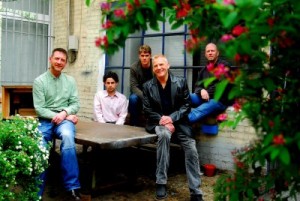
born in Giessen; studied film directing at Deutsche Film- und Fernsehakademie Berlin. He has studied with Martin Scorsese and Mike Newell. His first feature film was Heimatfilm with Fritzi Haberland. He has directed plays by David Mamet and Georg Büchner for Vagantenbühne; movie and TV acting included Baader, and Der letzte Zeuge. He lives in Berlin and teaches film in Kapstadt and Berlin.

Orpheus Descending

by Tennessee Williams

OrpheusDescendingTwo River County, a small town in the deep south of the USA, where death, sex and disaster are the topics of everyday gossip, where bigotry and racism are boiling very close to the surface. Here they all sit: Jabe, the dying patriarch and his frustrated wife, Lady; Beulah and Dolly, the town gossips; Carol, the black sheep of the town’s richest family.
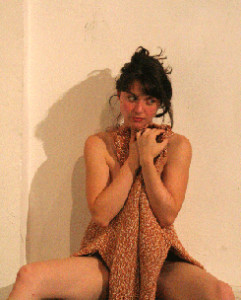
And then, in walks Snakeskin Val Xavier, a travelling musician from New Orleans, bringing life into a house where death seems to be the master and everyone seems to have lost hope and resigned themselves to their fate.

Orpheus Descending  could be Val´s story – the story of an outsider, a sensitive artist, a rebel without a cause, who stirs up volatile hostilities because of the passionate responses he inadvertently calls up in the more courageous and thirsty female citizens of a dried up town. But it is actually the story of Lady, a woman who finds hope and starts believing in herself again, who finally comes to full bloom, a wild orchid without a chance in a rotting society.

Lady Torrance is another one of Tennessee Williams´ arsenal of impressive female characters such as Blanche Dubois from A Streetcar Named Desire, or Maggie from Cat on a Hot Tin Roof, or Serafina delle Rose from The Rose Tatoo – women who heroically attempt to make a change in a male-dominated society and inevitably fail because the time is not ripe for them, yet.
Throughout his life Tennessee Williams was fascinated by the outsider, the free individual, namely the artist that was able to avoid what he called `the corrupted society´. In Orpheus Descending he connected the character of the American outsider with the mythological figure of Orpheus, singer and musician who descends into the underworld in an attempt to rescue his wife Eurydice after she has been bitten by a snake and abducted by Pluto, god of the underworld. His music so charms the guardians of Hades that Eurydice’s return is promised him on the condition that he not look back at her as she follows him out of the underworld. But Orpheus disobeys and by looking back loses Eurydice to the underworld.
Orpheus Descending was a project that Tennessee Williams worked on for over half his life and presented it in several different versions over a span of 20 years. As early as 1937 when he was 26 years old he wrote a version called Fugitive Kind for an amateur theatre company in St. Louis. Three years later the second try, entitled Battle of Angels, became Williams´ first professionally produced play, starring Hollywood legend Miriam Hopkins as Lady Torrance (who in this version was called Myra). All the characters and conflicts were already there although Battle of Angels didn’t have the sharpness, the elegance and the mythological references that 17 years later made Orpheus Descending a Broadway hit starring Cliff Robertson and Maureen Stapleton. Another three years later Williams´ again rewrote the project for the film version, The Fugitive Kind, with Anna Magnani and Marlon Brando, directed by Sidney Lumet.

“Man lässt sich gebannt von der düster-knisternden Atmosphäre einfangen…. und kann sich nicht satt sehen an den eindrucksvoll gezeichneten Charakteren.” (BERLINER MORGENPOST / January 14th, 2009)

The Woolgatherer

He thinks she’s cute. She acts like a prissy virgin. Turns out she has a major secret …

WOOLGATHERIf you saw the two at the cookie counter of a supermarket, you’d probably think: Those two? This delicate hypersensitive-looking young woman obviously dreaming of true love and that swearing wisecracking son of a truckdriver who surely is only looking for some
wham-bam-thank-you-ma’am kinda action? Never! – Rose and Cliff are both runaways from love.

They spend the night together in Rose´s apartment. He wants to touch, she wants his sweater.
But then again, if they start at the same point in opposite directions and the earth is a ball? Chances are, they might meet on the other side…
Who do you fall in love with?

Photo: Anja Renoth

The Caretaker

by Harold Pinter

Caretaker_web

English Theatre Berlin premiered its production of Harold Pinter´s masterpiece in May 2005 in its old space. Five months later Pinter was awarded the Nobel Prize for Literature 2006 and English Theater Berlin was about to move into new quarters –

– reasons enough for us to bring back the prodcution in the new space (not quite finished, to be honest, more of a transitional solution but all the more perfect for The Caretaker).

This is about political manoeuvering, fraternal love and language as negotiating weapon or a form of cover-up – a typically nasty “pinteresque” comedy with a seemingly simple arrangement: two brothers and a mysterious stranger meet up in a room. Their tactics of survival: 1. Find the right partner; 2. Talk talk talk; 3. Emotional intelligence might be helpful but sometimes a knife comes in handy. And never underestimate family ties….