etb English
Theatre
Berlin
International Performing Arts Center


Blog Archive

Isaac’s Eye

By Lucas Hnath
a staged reading from our SCIENCE & THEATRE series

isaacseye_keyvis_eyeonlyYoung Isaac Newton desperately wants to become a member of the club of clubs for scientists, the Royal Society. In order to convince Robert Hooke, the institution’s curator of experiments, he sticks a needle into his tear duct to prove that light is made of particles. Ouch!!! And if science won’t do it there is another way: Hooke keeps a detailed diary of his sex life …

Isaac’s Eye playfully blends the facts of Newton’s life with an equal dose of fiction to explore what great people are willing to sacrifice to become great people.

“Isaac’s Eye wins a whole mess of points for its originality. This odd little jeu d’esprit about the history of science considers immortal matters like male rivalry and overweening ambition from a willfully skewed perspective.” — The New York Times

Lucas Hnath’s other plays include Death Tax (Humana Fest/Steinberg Award), NightNight (short play for Humana Fest), A Public Reading of an Unproduced Screenplay about the Death of Walt Disney (Soho Rep) and Red Speedo (coming up at the Studio Theatre, Washington DC). A resident playwright at New Dramatists since 2011, Lucas Hnath has enjoyed playwriting residencies with The Royal Court Theatre, London and 24Seven Lab, New York.  He is a two-time winner of the Alfred P. Sloan Foundation Grant for his feature-length screenplays, The Painting, the Machine and the Apple and Still Life.  He received both his BFA and MFA from NYU’s Department of Dramatic Writing and is a lecturer in NYU’s Expository Writing Program.
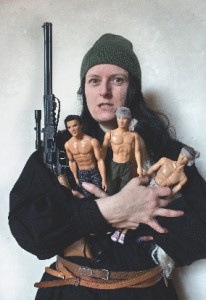

Bridge Markland: robbers in the box

bridge_robbers in the box

One of Germany’s most popular plays by one of Germany’s most popular authors, Friedrich Schiller – Radical and provocative at the time of its premiere in 1782, Bridge Markland presents it as a fast-speed One-Woman plus Puppets-Lip-Sync-Show with sexy Ken dolls as robbers and an original East German nutcracker.
Rebellion, envy, love, stubborness, hero-worship and desperation! Markland reinforces Schiller’s strong language with more then 150 songs, including many film themes ranging from Wagner´s Ride of the Valkyries to Lady Gaga, from Ennio Morricone to the theme from Dallas, Rammstein and a lot more great music.

Schiller’s translated text is spoken by actors from Berlin’s English-language theatre community like Peter Scollin from Playtpus Theater as the Old Moor, or Jeffrey Mittleman as Spiegelberg, and many others.

English-language premiere of robbers in the box: January 24th 2013 at English Theatre Berlin

Berlin Was Yesterday: Expatriate Traffic from the Kaiser to Kotti

Ten-Minute Play Competition 2013

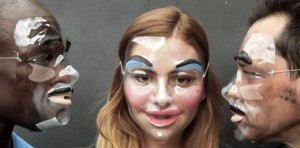
10MP_Image-Web“Nackt besser aussehen.” — Jiminy McFIT

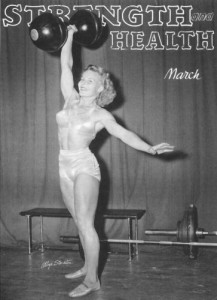
You ever feel like the whole ExPat thing has gotten a bit overblown? The gig seems flabby…puffed up and bloated by tag lines, slackers, and The New York Times. Remember the days when you really had to work for your Berliner Pfannkuchen? When it wasn’t just a 2€ Döner down the hole after a cheap flight from Clyde, NY, 14433? Shakespeare im Park Berlin* is looking to pump up your ETB Expat Month with its kale-spiced week of 10-minute performances – bringing Strength and Health to the month of March!

Five new pieces have been selected to form one closed-circuit loop of teeth grinding, bone bending, flat out hoofing-it through 15 cherry nooks and crannies of tender proscenium-sirloin and leaky backstage-gut. This is no Schabernack! Just as Frederick the Great dunked strapping young Dutchmen into his mud-swamped Prussian backwater to erect a delightful Baroque period French knockoff and characterized it “Frederician Rococo,” English Theatre Berlin is bringing in big, bulging guns for its fourth annual Ten-Minute Play Competition:

10MP_Strength&Health March_WEBThe winners were:

Symphony of Everyday Life by Claire Delaby & Alberto Di Gennaro / Culture by Emal Ghamsharick / Physical Exercises by Marie Hoffmann / Fluffers by Harvey Rabbit / Lass die Nutten tanzen by Antoine Hummel & Jacques Pradillon.

So put down the pot-stickers and hoist up your dumbbells for seven evenings of performance, all of which look even better in the buck.

* Shakespeare im Park Berlin is a multi-lingual, site-specific performance ensemble, founded in 2010.

This is how it goes

by Neil LaBute

English Theatre Berlin: THIS IS HOW IT GOESThe American Dream – according to Neil LaBute
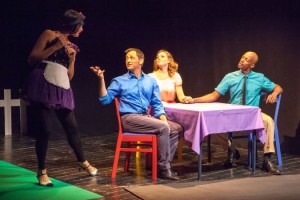
Cody and Belinda seem to be living the American Dream: a rich couple living in a snug suburb, with two kids and their whole lives ahead of them. The fact that Cody is African American and Belinda is not, is a footnote in their otherwise picture-perfect lifestyle. But this is not their story; its the story of an old high school classmate who comes to live with them, who begins spinning a much different tale of resentment, racism, and the facades that we all maintain in order to stay within the lines of decency. Once those lines have been crossed, nothing can ever return to the way things used to be.

This Is How It Goes is about the stories we believe, what we let others believe, and the lives we pretend to be living. It is a reminder that the truth is rarely pure, and never simple.

English Theatre Berlin: THIS IS HOW IT GOESNEIL LaBUTE is one of America´s most controversial playwrights; born in Detroit in 1963, he has written twenty plays (like BASH, The Shape of Things, Fat Pigs or reasons to be pretty) and directed nine movies (like In the Company of Men, Nurse Betty or Lakeview Terrace).

BRIAN BELL is a director and actor based in Chicago. ln 2004 he completed a directing internship at Carrousel Theater an der Parkaue in Berlin and went on to direct an original piece The Warrior and Naomi Wallace’s The Retreating World at the Acud Theater in 2005. Brian was invited as fellow of the Internationales Forum des Berliner Theatertreffens 2011. He is a directing fellow of the Goethe Institute’s Young Theatre Artists in Germany Program, where he assisted on a production of Dantons Tod (dir: Nuran David Callis) at the Staatstheater Stuttgart in 2011. In Chicago Brian is the artistic director of Cabaret Vagabond and has directed for Collaboraction, Caffeine Theatre, and at Adventure Stage Chicago, where he is an ensemble member. He has toured nationally as an actor with the Chamber Theatre of Boston and worked regionally for the last two summers at the Theatre at Monmouth – The Shakespeare Theatre of Maine. Brian has just completed devising and performing Projekt G – A Theatrical Investigation of Happiness in Tokyo, which will be remounted at the Hessisches Landestheater Marburg in September.

supported by  US_NewLogo_Flag_WEB

Photos: Christian Jungeblodt

Bridge Markland: faust in the box

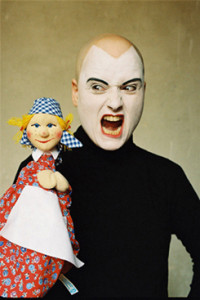
faust_in_the_boxJohann Wolfgang Goethe’s Faust as a one-woman-show featuring hand puppets and pop music. With an intense physicality, Bridge Markland performs high speed changes between Mephisto, Faust and Margarete/Gretchen using the puppets as her opponents. She acts to a sound collage made up of the text of the play and popular music from different generations.

“… With almost demonic facial twitches and contortions, she paints a Joker-like, mad… world, changing between the three characters of Faust, Mephistopheles and Gretchen …” BBC Scotland

“… it works so well I became fascinated to see and hear just what was about to happen next. … It is superbly performed and very very cleverly written and designed …”
www.one4review.co.uk

“… The parallels between the well known text and it’s translation into pop songs of the past four decades are impressive and funny at the same time. Bridge Markland walks on the rather narrow edge between modern debate and persiflage. When Margaret recognises at the end that she is on AC/DCs “Highway to hell”, this borderline finally becomes blurred in a great and new attempt to interpret the classic for many generations. This comprehensive attempt was successful. “ Mannheimer Morgen

Bridge Markland, the Berlin dance-theatre performance artist, is a virtuoso in role-play and transformation. An artist who effortlessly crosses the boundaries between sub- and high culture, between dance, theatre, performance, children’s – and puppet-theater.

faust in the box saw several successful international tours over the years

Photo: Dirk Holtkamp-Endemann

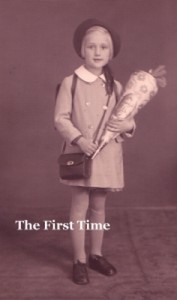
The First Time

Close your eye. Close them.
Can you remember it like it was yesterday, or is everything blurred and indistinct?

TMP2012_KID


Your first day at school?
Your first bike?
Your first kiss?
Your first dance?
Your first job?
Your first fight?
Your first love?
Your first hate?


The winners were:

Golden Gates by Rosie Skan

My First Apocalypse by Maxwell Flaum

The Red Couch by Marie Franz

Spin the World Around by Kate McCane

Authorization Breakdown by Martin Esters

Erika Hughes studied at NYU’s Tisch School of the Arts/Playwrights Horizons Theatre School and holds a Ph.D. in Theatre and Drama from the University of Wisconsin. She has over fifteen years of experience as a director, designer and performer.

Designer Jeans Genes

Biopolitical scenarios from a terribly blessed future

Will synthetic biology provide us with ”improved” children, never-seen-before pets and ideal partners? Will we no longer accept our naturally-given characteristics, but rather enhance ourselves to become an ideal version of ourselves to reach our goals in life? Will the genetically engineered, beautified and improved half of humanity rule, while the other not so fortunate (or rich) half serves? Will we be able to eradicate deadly genetic diseases?

The answers to these and similar questions will come not in some distant utopia, but within our lifetimes. There will be unpredictable social consequences and challenges that our children will soon have to deal with. In the Science&Theatre school project ‘Designer Jeans Genes‘, some of them are already starting today!

The project was part of SCIENCE & THEATRE 2012 and consisted of performances and an exhibition exploring synthetic biology, developed by students of Heinrich-Schliemann-Gymnasium, Humboldt-Gymnasium, and Leibniz-Schule.
supported  by    Kulturprojekte Berlin_Logo_100pixbreit     fu_logo_150

The exhibition on genetic experiments and artistic studies of the DNA as well as ethical viewpoints on the subject by students of the three schools opens on February 6 at 6pm and is open on performance days one hour before showtime until March 10th.

„Vielen Dank für dieses Erlebnis! Es sollte viel mehr solche Projekte geben die den Schülern nicht nur Englisch und Schauspielern beibringen, sondern sie auch noch mit einem so komplexen Thema vertraut machen. Die Debatte über die Gentechnik ist ideologisch so aufgeladen und die Vorurteile in den Köpfen sind so festgefahren, dass es mich sehr verblüfft hat mit welcher Offenheit und Sachlichkeit die Schüler an dieses Thema herangegangen sind. Aus dieser Offenheit kamen sehr phantasievolle und interessante Ansätze die mich wirklich begeistert haben. Solche Erfolge haben wir mit vielen Jahren Aufklärung in Schulen nicht erreicht! Euch ist es gelungen, die Wissenschaft zum Thema der Schüler zu machen und nicht zu einem Lehrfach in der Schule. Ich wäre sehr froh, wenn man so etwas auch für die Grüne Gentechnik machen könnte.“ – Inge Broer, Professorin für Agrobiotechnologie und Begleitforschung zur Bio- und Gentechnologie, Agrar-und umweltwissenschaftliche Fakultät, Universität Rostock

Photograph 51

by ANNA ZIEGLER

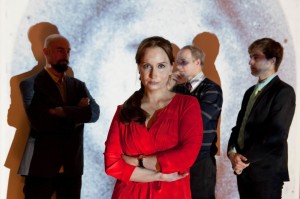
Photograph51_Bau_01_c_RGBA science play about a revolutionary discovery – and how the boys took over

In the early 1950s the young Jewish scientist Rosalind Franklin had to struggle with a frustratingly male-dominated science establishment at King´s College in London. Some of her colleagues even refused to acknowledge her doctoral title, while access to the faculty club, which was reserved to men, remained denied to her.

After months of work, she succeeded in taking the X-ray photograph that became the turning point for elucidating the DNA double helical structure: photograph 51. However, the credit for this revolutionary scientific discovery was given to the men who used the picture without her knowledge; Franklin´s crucial contribution went unacknowledged for decades.

When James Watson, Francis Crick and Franklin´s colleague Maurice Wilkins received the Nobel prize in 1962, she had been dead for four years.

English Theatre Berlin; PHOTOGRAPH 51In a nutshell, Anna Ziegler‘s play shows the making of an outstanding scientific discovery in a bone-dry, ritualized and women-excluding male establishment, in which an emotional minefield, social coldness and hierarchies, antisemitism and ferocious fighting for recognition and scientific priority went hand-in-hand with scientific curiosity, meticulousness and juvenile enthusiasm. (in 1952, James Watson was just 24 years old, Rosalind Franklin was 32 !).

Photograph 51 was the third production in our Science & Theatre program.

Supported by   Druck  fu_logo_150

Image: Magnus Hengge / Photos: Christian Jungeblodt


Lady Lay

a new play by LYDIA STRYK

“I´ll let you be in my dreams if I can be in yours.”

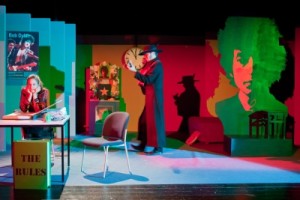
English Theatre Berlin > LADY LAYMarianne has worked at the Berliner Arbeitsamt all her life and then she hears Bob Dylan on the radio and the Wall falls down.
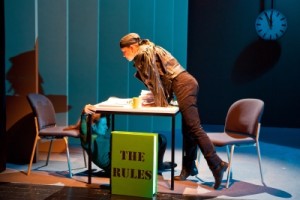
Although she can hardly understand the words, she takes a journey—both joyful and terrifying—into Dylan’s world, putting her very existence in jeopardy.

“There must be some way out of here …”

“Welcome to the Office of Employment. Berlin Division, District Seven. It is run as an efficient operation. And it is. It’s a system, after all. It could run without us. Maybe it will one day. It has rules. But behind the rules is reality. And no two things could be more opposite. Rule: You must work. Reality: There is no work. Rule: We provide work. Reality: there is no work. Rule: Our economy and survival depend on work. Reality: there is no work. Not here. Not any more.”

Lady Lay takes a joy ride through life’s rules and regulations. But what is freedom? And can Bob Dylan take you there?
A joy ride through the Arbeitsamt to Freedom!

“Yippee! I’m a poet, and I know it. Hope I don’t blow it.”

English Theatre Berlin > LADY LAYLydia Stryk was born in DeKalb, Illinois, birthplace of barbed wire and is now based in Berlin. She is the author of over a dozen full-length plays including Monte Carlo, The House of Lily, The Glamour House, American Tet and An Accident, which have been part of festivals around the United States and produced at, among others, Denver Center Theatre, Steppenwolf Theatre Company, Victory Gardens, HB Studios, The Contemporary American Theatre Festival, Magic Theatre, and in Germany at Schauspiel Essen, Theaterhaus Stuttgart and Forum Theater with Schauspiel Independent and featured at Biennale Bonn. Her plays are published by Broadway Play Publishing and Per Lauke Verlag, and excerpts appear in numerous anthologies including Acts of War: Iraq and Afghanistan in Seven Plays from Northwestern University Press. American Tet was produced at the English Theatre Berlin in November 2008.

Photos by Christian Jungeblodt

My Romantic History

by D C JACKSON

MRH_Web

“I suppose there comes a point when you have to face that you’re just ‘that age’ and that if you’ve got a man who isn’t a retard, a rapist or a Rangers supporter then he’s probably about the best you’re going to get.”

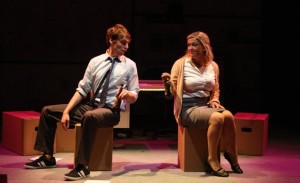
My Romantic History takes a sharp, hilarious and affectionate look at modern relationships and the rocky road to true love. Office colleagues Tom and Amy´s drunken one-night stand seems to be morphing into a full-blown relationship before their very eyes, but before they can face the future, they’ll have to deal with the ghosts of relationships past…

“The genius of this play is that it acknowledges the ambivalence of postmodern sexual lives – the lack of commitment, the coldness, the sense that reality never quite measures up to some plastic ideal – while simultaneously overcoming all that with the wit, the humanity, the ability to laugh, learn, and move on, that is the real redeeming quality of our species. Jackson’s clear-eyed but brilliant comic invention is a joy, as is his inimitable way with words.” The Scotsman

MRH2_web
First produced by The Bush Theatre and Sheffield Theatres in association with Birmingham Repertory Theatre on 5th August 2010 at the Traverse Theatre Edinburgh.

D. C. JACKSON is a Glasgow-based writer. His plays include The Wall (2008), The Ducky (2009) and The Chooky Brae (2010), a trilogy of plays written for Borderline Theatre, Glasgow); Company Policy (2010), Out on the Wing (2008), Matinee Idle (2006) and Drawing Bored (2006), all for the A Play, A Pie and A Pint series at Oran Mor, Glasgow. He has written for BBC Radio Scotland and Radio 4. He is currently under commission to the Royal Court Theatre and the National Theatre of Scotland.

Image: Anna Clark / Photo: Peter Groth

supported by  British CouncilNEW_BLLUE_180breit