etb English
Theatre
Berlin
International Performing Arts Center


Blog Archive

The Extremists

by CJ Hopkins

Spin or fact? Theater or reality? A biting, original political satire that challenges audiences of any political affiliation, The Extremists is a labyrinth of wordplay and mind games in which a television talk show host and his guest who wrote a book about terrorism get lost in their own doublespeak … or are they really double-agents, subversively reprogramming our sound-byte-saturated minds?

This is a funny and fast-paced work of fiction, not an extract pulled from today’s headlines or news shows … but really, what’s the difference anymore? What does it say about the state of democracy, when Image the majority of citizens in the most powerful democratic country in the
world can be led to war by nothing more than sophisticated marketing tactics? How free are we really? Are we thinking critically? How could we be, having been subjected to non-stop media manipulation from the time we were born?

The word `insane´ is one of the most frequently heard words on the stage … It describes the evening very well. … The Extremists begins as harmless media satire, a conversation in which the host and the invited expert toss empty phrases back and forth … Hopkins builds a construct of ideas out of their rhetoric, until everything revolves around one thing: What is the truth for the good guys, and what is it for the bad guys? … What is the reality? … Intellectual theater in the truest sense. Tagesspiegel / 17 Feb 2009

CJ Hopkins’ writing for the stage has been an exploration of the manipulative power of language and mimesis. In his award-winning plays, Horse Country and Screwmachien/Eyecandy, he fuses traditional dramaturgy with linguistic and performative strategies borrowed from other discourses, such as marketing tactics, political speeches, psychological conditioning, hypnotic suggestion- while at the same time, he lays bare the machinery of those discourses.
In The Extremists, as in his earlier plays, Hopkins’ main subject is authoritarianism, both externalised in society and internalised within our unconscious minds.
Humor and wordplay keep the work entertaining. However, Hopkins’ real artistic goal is to create a state where we are forced to question the nature of the event unfolding before us, and the power that event is exerting on us, believing that,
in this state of radical uncertainty, off balance and questioning, we become more awake, more aware of our own conditioning and programming, and thus, hopefully, more able to change it.

CJ Hopkins began writing for the stage in 1987. In 1994 he was awarded a Drama League of New York Developing Artist fellowship, and, in 1995, a development residency at Mabou Mines. The premiere of his first full-length play, Horse Country, was presented at HERE Arts Center in New York City in 1997. Since then, Hopkins’ works, including A Place Like This, The Installation, How to Entertain the Rich, The Position, Cunnilinguistics, Texas Radio, and various experimental texts, have been produced regularly in New York, and in Los Angeles, Philadelphia, and Chicago, among other US cities.

In 2002 Horse Country  won the most prestigious writing award of the Edinburgh festival fringe, the Scotsman ‘First of the Fringe Firsts.’ Since then, Horse Country has toured and been produced internationally, playing theatres and festivals including London, Edinburgh, Sydney, The Du Maurier World Stage Festival in Toronto, the Brighton Festival, and the Noorderzon Festival in Holland. In 2004 it again won a ‘Best of the Fringe’ award, this time at the Adelaide Fringe Festival.

In 2005, the world premiere of Screwmachine/Eyecandy, or: How I learned to Stop Worrying and Love Big Bob was presented at the Edinburgh Festival Fringe, where it won a Scotsman ‘Fringe First’. The New York premiere was presented at 59E59 Theaters in the Spring of 2006.

Since 2004, Hopkins has been based in Berlin, Germany, where, in 2006, he was commissioned to write and direct a site-specific play, Der Aufstand, for the Freie Universität Berlin. In 2007, Hopkins was commissioned by the Technische Fachhochschule Wildau, in Brandenburg, to create a site-specific multimedia piece, Nur Gerede, keine Taten, which was presented at the University in October.

Although based in Europe, Hopkins maintains close ties to New York, where he is associated with Clancy Productions, and with director John Clancy, with whom he has collaborated on several productions since 1999.

Walter D. Asmus

is a well-known German theater director who worked with Samuel Beckett on many occasions for the stage and television, from the time they first met at the Schiller-Theater in Berlin in 1974. He became his assistant director on their famous production of Waiting for Godot. He has directed all of Beckett’s plays internationally including Waiting for Godot at the Brooklyn Academy of Music, New York in 1978 and the Gate Theatre, Dublin in 1988. His television work includes Footfalls, Rockaby and Eh Joe with Billie Whitelaw, and a French version of Waiting for Godot with Roman Polanski as Lucky.

He was co-organizer and Artistic Director of the international festival, `Beckett in Berlin 2000´. In 2000/2001 he directed the filming of Footfalls with Susan FitzGerald for the `Beckett on Film´ project in Dublin. In 2004 he directed Waiting for Godot at 7 Stages, Atlanta and for the Rubicon Theatre in Ventura, California. In 2005, he directed the first Chinese production of Endgame in Mandarinin Shanghai, China. Recently, he directed a stage adaptation of Beckett’s novella First Love forthe Writer’s Festival in Sydney. Walter D. Asmus was a friend of Beckett’s until the writer’s death in 1989.

Del Hamilton

As co-founder of 7 Stages, Del Hamilton has been a part of the company since its inception in 1979. As Artistic Director, he has directed over 60 productions at 7 Stages, including numerous plays by Sam Shepard and, most recently, The Little Prince by Antoine de Saint Exupery and Who´s Afraid of Virginai Woolf? by Edward Albee. He has also acted in numerous plays. Del directed a very successful production of One Flew Over the Cuckoo´s Nest at Teatr Nowy in Poznan, Poland, and he has acted and directed at many notable theaters in Atlanta, New York, London, Paris, Belgrade, Johannesburg and Amsterdam. Del is the author of several plays and has received numerous awards.

Tim Habeger

Co-Founder and Artistic Director of PushPush Theater, is a director and writer for film and theater.
In New York City, he worked with Ellen Stewart at La Mama ETC, was in the company at The Neighborhood Group Theater and served as artistic director of Bridge Arts. He worked at 7 Stages Theater in Atlanta where, among other tasks, he was Joseph Chaikin’s assistant, and he helped coordinate artistic workshops in coordination with a Rockefeller Foundation sponsored New Play Project, and a US/Netherlands multi-year touring program.
He completed was certified in dance and drama in New York’s Artist-in-Residence program and taught for film for three years at AMDA.
Bloodwater

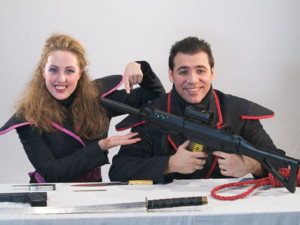
two short plays by Eugene O’Neill, presented by InOktober Productions (Berlin)

Before Breakfast (1916), one of Eugene O’Neill’s earliest plays, contains little action, though it is charged with conflict. A wife onstage berates her offstage husband for twenty minutes. The man remains unseen and unheard, and yet we are made to understand through her words how he has contributed to their bitter and estranged relationship. ImageThe story’s resolution, as O’Neill wrote it, is horrifying and bloody, showing little in the way of hope for the couple. Without changing a single word of the text, this inventive staging aims to present a more robust version of O’Neill’s vision. Jovanka von Willsdorf composed songs especially for this production, using O’Neill’s text as lyrics. The strange sonic miniatures are like breakthroughs, to reveal the beauty and pain hidden just beneath the surface of the bitter words.

In the Zone (1917). The crew on board the Glencairn, a freighter ship carrying ammunition during wartime, live in constant fear of bombs and U-boat attacks. In an atmosphere charged with terror of imminent death, any small deviation from the norm becomes suspect. So it is that Smitty, a young boy on the ship who tends to keep mostly to himself, comes under suspicion of being a German spy. This staging achieves its emotional impact with broad, Imagesimple gestures: what’s striking about the story, written almost one hundred years ago, is it familiarity, its relevance to our modern experience of wartime terror and paranoia. Though the performers move through their roles with dreamlike calm, a deep disquiet is at work throughout.

Bloodwater’s strength lies in its intimacy and sense of confrontation. The stage was conceived to resonate underfoot like a giant musical instrument. The audience sits at eye level with the performers, almost within reach. These are stories presented close to the skin, with humor and humanity.

InOktober Productions is a New York/Berlin ensemble of theater artists. Current InOktober productions tend to ruminate on one of two broad subjects: love in its extremes, and what it means to be American. To keep up with their ongoing work, including the development of the final part of their Eugene O’Neill trilogy, please visit www.inoktober.com

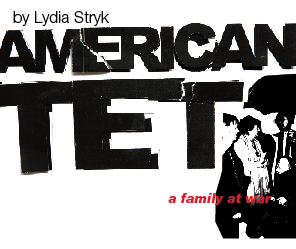
American Tet

by Lydia Stryk

american_tet_ohneAn army family at war …

American Tet enters into the lives and world of a military family, the Krombachers. The father, Jim, served in Vietnam before building a career in the Army; while the son, Danny, currently serves as a military policeman in Iraq. And then there is Elaine, an exemplary military wife and mother – an upright patriot who teaches the spouses of new soldiers the ins and outs of military life.

The family, including the rebellious daughter, Amy, await Danny who is coming home on leave. Danny’s return brings unexpected complications into the black and white world of duty and pride. Coming home, too, is Danny’s friend, Angela, who has been gravely injured in the war. Meanwhile, Elaine encounters a woman from another world, Nhu, – from Vietnam – who unsettles her and sets about the unraveling of her unquestioned assumptions and world.

American Tet is a brutal account of the effect of the current war in Iraq and past wars, on soldiers and soldiers’ families. What´s important? Who is right? How does terror begin and most of all ­ why?

“It’s not a pretty play. But it’s not a pretty world.” Lydia Stryk

“Ein ziemlich beeindruckendes Stück…, das sich keine wohlfeile Moral leistet oder seine Figuren denunziert. (Es) liefert vielmehr eine sehr authentische Zustandsbeschreibung jenes tief verunsicherten US-Amerika, das sich nun Barack Obama zum Präsidenten wählte…” TAZ (Esther Slevogt)

Lydia Stryk
born in DeKalb, Illinois, trained to be an actress at the Drama Centre, London, later studied history, education and journalism. She has a BA in History from Hunter College, an MA in Journalism from NYU and a Ph.D. in Theatre from the Graduate Centre of the City University of New York.
She is the author of fifteen full-length plays and a few short ones. Her work has been anthologized in America and published and translated into German by Per Lauke Verlag, Hamburg. Her plays have been seen at festivals around the United States and in Europe and produced at many theatres throughout the US, and in Germany at Schauspiel Essen and Theaterhaus Stuttgart. She lives in Berlin
Daniel Krauss
born in Giessen; studied film directing at Deutsche Film- und Fernsehakademie Berlin. He has studied with Martin Scorsese and Mike Newell. His first feature film was Heimatfilm with Fritzi Haberland. He has directed plays by David Mamet and Georg Büchner for Vagantenbühne; movie and TV acting included Baader, and Der letzte Zeuge. He lives in Berlin and teaches film in Kapstadt and Berlin.

Orpheus Descending

by Tennessee Williams

OrpheusDescendingTwo River County, a small town in the deep south of the USA, where death, sex and disaster are the topics of everyday gossip, where bigotry and racism are boiling very close to the surface. Here they all sit: Jabe, the dying patriarch and his frustrated wife, Lady; Beulah and Dolly, the town gossips; Carol, the black sheep of the town’s richest family.
And then, in walks Snakeskin Val Xavier, a travelling musician from New Orleans, bringing life into a house where death seems to be the master and everyone seems to have lost hope and resigned themselves to their fate.

Orpheus Descending  could be Val´s story – the story of an outsider, a sensitive artist, a rebel without a cause, who stirs up volatile hostilities because of the passionate responses he inadvertently calls up in the more courageous and thirsty female citizens of a dried up town. But it is actually the story of Lady, a woman who finds hope and starts believing in herself again, who finally comes to full bloom, a wild orchid without a chance in a rotting society.

Lady Torrance is another one of Tennessee Williams´ arsenal of impressive female characters such as Blanche Dubois from A Streetcar Named Desire, or Maggie from Cat on a Hot Tin Roof, or Serafina delle Rose from The Rose Tatoo – women who heroically attempt to make a change in a male-dominated society and inevitably fail because the time is not ripe for them, yet.
Throughout his life Tennessee Williams was fascinated by the outsider, the free individual, namely the artist that was able to avoid what he called `the corrupted society´. In Orpheus Descending he connected the character of the American outsider with the mythological figure of Orpheus, singer and musician who descends into the underworld in an attempt to rescue his wife Eurydice after she has been bitten by a snake and abducted by Pluto, god of the underworld. His music so charms the guardians of Hades that Eurydice’s return is promised him on the condition that he not look back at her as she follows him out of the underworld. But Orpheus disobeys and by looking back loses Eurydice to the underworld.
Orpheus Descending was a project that Tennessee Williams worked on for over half his life and presented it in several different versions over a span of 20 years. As early as 1937 when he was 26 years old he wrote a version called Fugitive Kind for an amateur theatre company in St. Louis. Three years later the second try, entitled Battle of Angels, became Williams´ first professionally produced play, starring Hollywood legend Miriam Hopkins as Lady Torrance (who in this version was called Myra). All the characters and conflicts were already there although Battle of Angels didn’t have the sharpness, the elegance and the mythological references that 17 years later made Orpheus Descending a Broadway hit starring Cliff Robertson and Maureen Stapleton. Another three years later Williams´ again rewrote the project for the film version, The Fugitive Kind, with Anna Magnani and Marlon Brando, directed by Sidney Lumet.

“Man lässt sich gebannt von der düster-knisternden Atmosphäre einfangen…. und kann sich nicht satt sehen an den eindrucksvoll gezeichneten Charakteren.” (BERLINER MORGENPOST / January 14th, 2009)

The Harvest Chamber

For sixty minutes, you are transferred one-hundred years into the future…

…where machines are our gods and human contact is non-existent. Welcome to Gens Incorruptus where members of the society are only intimate with their keyboards.

One day, a male and a female are chosen take part in an experiment. They must meet face to face and form a physical and emotional bond. Is this possible?

Join GI7849 & GI3319, now reborn as Adam and Eve, to find out how it feels to speak for the first time, to meet another being in the flesh and blood, to discover that male and female can be man and woman.They have one hour to perform the task and produce a youngling as directed. Will they succeed?

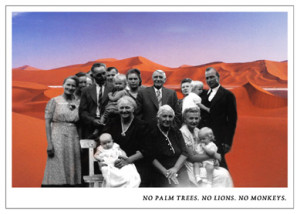
Yvette Coetzee: NO PALM TREES. NO LIONS. NO MONKEYS.

My family has always been on the ‘perpetrator’ side. Great-grandfather: soldier in the Herero War. Don’t know how many he killed. Grandfather: Nazi. Parents and I: whites in the Apartheid system. And then I left Africa to its fate, and moved to Europe.

NoPalmTreesIf one is born “white” in Africa, paging through the family albums can raise a lot of uncomfortable questions. Yvette Coetzee, author and actress, sets out to look for the answers. In 1904 her German great-grandfather went to (then) South West Africa to fight as a soldier in the Herero War, the first genocide of the 20th century. Afterwards, he bought a farm west of Windhoek, where the author’s Grandmother lives to this day. The 89-year-old speaks German, watches German TV, clings to “her” culture in modern day Namibia.
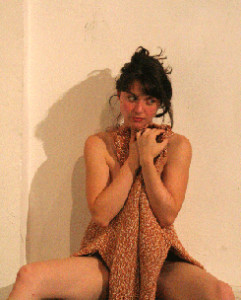
The private anecdotes of everyday events spanning four generations of a migrant family history, reflect a century of world history: from the beginning of the short German colonial period – through the Third Reich as experienced from the other end of the world – through Apartheid and independence to the current fears of white landowners that their land could be repossessed, and the African “boat people” trying to reach European coasts.
The play, a solo combining elements of acting, performance and object theatre, looks for the connection between these events, attempts to find historic “truths”, and investigates personal responsibility in the face of such an inheritance.

Photo: YC

The Woolgatherer

He thinks she’s cute. She acts like a prissy virgin. Turns out she has a major secret …

WOOLGATHERIf you saw the two at the cookie counter of a supermarket, you’d probably think: Those two? This delicate hypersensitive-looking young woman obviously dreaming of true love and that swearing wisecracking son of a truckdriver who surely is only looking for some
wham-bam-thank-you-ma’am kinda action? Never! – Rose and Cliff are both runaways from love.

They spend the night together in Rose´s apartment. He wants to touch, she wants his sweater.
But then again, if they start at the same point in opposite directions and the earth is a ball? Chances are, they might meet on the other side…
Who do you fall in love with?

Photo: Anja Renoth

The Caretaker

by Harold Pinter

Caretaker_web

English Theatre Berlin premiered its production of Harold Pinter´s masterpiece in May 2005 in its old space. Five months later Pinter was awarded the Nobel Prize for Literature 2006 and English Theater Berlin was about to move into new quarters –

– reasons enough for us to bring back the prodcution in the new space (not quite finished, to be honest, more of a transitional solution but all the more perfect for The Caretaker).

This is about political manoeuvering, fraternal love and language as negotiating weapon or a form of cover-up – a typically nasty “pinteresque” comedy with a seemingly simple arrangement: two brothers and a mysterious stranger meet up in a room. Their tactics of survival: 1. Find the right partner; 2. Talk talk talk; 3. Emotional intelligence might be helpful but sometimes a knife comes in handy. And never underestimate family ties….

HYSTERIA

HYSTERIAThe world is ending. And it’s happening at table 9…

TOTAL THEATRE AWARD at the Edinburgh Festival Fringe 2006
“Beautifully observed … wonderfully witty … I laughed until I cried” (The Guardian)

Inspired by T.S. Eliot’s poem of the same name, Hysteria makes us witnesses to a painstaking attempt at social interaction. A man and a woman are on the most awkward dinner date of their lives. He is an academic whose research into modern day neuroses is threatening his sanity, she is an events manager who’s terrified of missing the party. Caught in the middle is their mortified waiter. With humour, physicality and visceral sound and lighting, Hysteria draws its audience into a world where the main course is a fight for survival and a banana can move you to tears.

Hysteria premiered at the Edinburgh Fringe Festival 2006 where it won a Total Theatre Award and was shortlisted for the Carol Tambor Award.

Inspector Sands is a collective of award-winning theatre-makers with a body of acclaimed work between them. Hysteria is a co-production with Stamping Ground Theatre whose A Quiet Afternoon received rave reviews at the Edinburgh Fringe 2004 and on its UK and Irish Tours.

Brief Interviews With Hideous Men

based on the short stories by David Foster Wallace

Brief_InterviewsThis compilation of dialogues and monologues delves into men´s fear of truly being seen or understood. The loneliness, aggression, and rawness of the characters are laid bare by a series of short interviews conducted by a silent female figure. Movement and visual passages disrupt the text to highlight suppressed motives.

Should we be witnessing this? How is the seemingly harmless partially loaded?

“… the inability to make another feel what it´s like to be unable to make another feel.” David Foster Wallace