etb English
Theatre
Berlin
International Performing Arts Center


Blog Archive

The City Ghettos of Today: Uninhabited Island

This installation and performance constitute the sixth stage of the trans-European project The City Ghettos of Today: Exploring the Memory and Present Day Reality of Migrant Communities in European Cities.

At the heart of the project The City Ghettos of Today is a desire to redefine and reexamine the concept “ghetto” in the context of today’s closed migrant districts. Through artistic creation and sociological research, we aim to create a space in which to examine and discuss the multiple stories emanating from Europe’s migrant “ghettos”. How do we talk about “ghettos” today? Is it possible – and even necessary – to redefine the word in a manner that more accurately reflects the multiple realities that constitute our contemporary urban landscapes? What role do “ghettos” play in constructing a European identity? What factors contribute to phenomena of “ghettoization” in contemporary Europe? What are the dynamics that contribute to the implantation of migrant communities throughout Europe today and how do they connect to the collective memory of Europe’s past?

The City Ghettos of Today entails a series of workshops open to local communities in different European cities – Warsaw, Paris, Bologna, Milan, Helsinki, Berlin and Antwerp. Run by artists and cultural actors, each workshop installment will conclude with an art installation and public debate on the project’s themes in each of the cities listed above. This European collaboration will conclude in Warsaw in December 2014 with a large-scale installation-performance and debate that will bring together materials culled from each of the participating city workshops. The project unites artists, cultural actors, academics and social workers in order to explore the broad themes of “ghetto” and “migration districts” in participating European cities. The City Ghettos of Today reflects the interdisciplinary dimension of the Strefa WolnoSlowa foundation, which combines academic and theoretical methodologies with practices of artistic and cultural creation. Through artistic reflection and intellectual research, this collaborative project seeks to unravel the complex and problematical theme of “migrant ghettos” in contemporary Europe, paying particular attention to various definitions and visions of ghettos within the contexts of Warsaw, Paris, Bologna, Milan, Helsinki, Berlin and Antwerp.

The City Ghettos of Today in Berlin: Uninhabited Island

November 4 – 13, 2014

Uninhabited Island situates The City Ghettos of Today in the Berlin site-specific context of a rapidly changing city, from the “Cinderella” of European capitals back in the 1990s to the present “place to be”. The focus will be placed on the urban and social changes which are currently affecting the city, such as gentrification and the resulting displacement of low-income inhabitants, often including those with a “migration background”. Former immigrant and poor districts often associated with the idea of “ghetto”, like Kreuzberg or Neukölln, have received unprecedented hype and developed into magnets for tourists and real estate investors during the last five years.

Over the course of this, these districts, once the furthest limits of West Berlin and now central districts in the reunified German capital, have been increasingly populated by a new wave of immigrants. These newcomers, primarily from comparatively rich Western countries, active in the creative industries and often using English, not German, as a working language stand in stark contrast both to the pre-war German residents of Kreuzberg and Neukölln as well as the first wave of post-war immigrants, coming primarily from Turkey through a guest worker program established by West Berlin.

How do these distinct groups see themselves today? How do they see each other? Can they even communicate? 25 years after the Fall of the Wall, Berlin is still an island. An island full of existing inhabitants and constantly arriving new inhabitants. An island whose international glamorization and hyping in recent years have radically transformed living conditions in these previously impoverished, primarily migrant districts in the form of unsustainably increasing rental costs. An island that everyone wants to obtain or defend a piece of. The “struggle” for the island will be examined with representatives from these various groups through laboratories and workshops.

The Berlin-based part of the project is organized in cooperation with English Theatre Berlin | International Performing Arts Center, OnElf Theater and Performance Collective, European Alternatives and Tanz der Kulturen e.V.

  1. Artistic Workshops: Creating Uninhabited Island

Beginning on November 4, the international artistic team of The City Ghettos of Today from Poland, Italy, Finland and France together with the local partners English Theatre Berlin | International Performing Arts and OnElf Theater and Performance Collective will invite an heterogeneous group of participants based in Berlin, old and new Berliners, from Germany and from beyond, to work and reflect on the changing living and social conditions in the city. Starting from the stories and biography of the participants as a representative “sample” of contemporary Berliners and in a provocative relation with one another, a collective, controversial and complex portrait of the city will be created and strategies and desires for a common future will be rehearsed.

The results of this collective undertaking will be presented on Thursday, November 13 at 8:00 pm at English Theatre Berlin | International Performing Arts Center.

Workshops will be led an artistic project team consisting of: Pietro Floridia (Cantieri Meticci, Bologna), Alicja Borkowska (Strefa WolnoSłowa, Warsaw), Daniel Brunet (English Theatre Berlin | IPAC), Elena Basteri, Christian, Willhelm and Johannes Kup (OnElf Theatre and Performance Collective), Mehmet Ballikaya (Tanz der Kulturen), Linda Fahssis (Cie Check Points, Paris), Tomasz Gromadka (Strefa WolnoSłowa, Warsaw), Piotr Mikuć (Strefa WolnoSłowa, Warsaw), Marek Płuciennik (Ptarmigan, Helsinki), Alejandro Olarte (University of Arts of Helsinki – Center for Music and Technology)


  1. Debate: Gentrification? It’s the Art, Stupid!


When: November 8, 2014, 4:30 pm

Where: English Theatre Berlin | International Performing Arts Center, Fidicinstr. 40, 10965, Berlin

Moderated by sociologist Baris Ulker of Technical University Berlin, Center for Metropolitan Studies, artists, activists and academics will discuss Berlin, gentrification, social and urban change as well as the role of the artist as both catalyst of gentrification and as producer of alternative spaces and counter narratives of the urban and social environment.

Participants: Baris Ülker (Technische Universität Berlin, Center for Metropolitan Studies), Elena Basteri (Onelf Theater and Performance Collective Berlin), Renata Włoch (Sociology Institute of Warsaw University), Daniel Brunet (English Theatre Berlin | IPAC), copy & waste, Michelle Teran, Helga Dressel (Co-curator of the project Haus der 28. Türen),


  1. Spotlight on the Installation


When: November 13, 2014, 8:00 pm

Where: English Theatre Berlin | International Performing Arts Center, Fidicinstr. 40, 10965, Berlin

Admission to all events is free of charge.

This project is financially supported by the European Commission – Program Europe for Citizens and co-financed by the Evens Foundation

Logotyp_Europa dla Obywateli Logotyp_Evens Foundation

Nasty Peace (copy & waste)

off-site event!
kottbusser tor, kreuzberg
Meeting point Kohlfurter Straße 33, 10999 Berlin!

there are only 30 tickets available for each performance. we highly recommend purchasing tickets in advance.

By copy & waste

winter was coming.
But we didn’t want to know.

Step right up and place your bid for a piece of Kreuzberg! Take part in an auction of the exotic! Enjoy the unbelievable feeling of not having to worry about anybody else!

It’s not great living in the 21st century: people have been protesting the rapidly rising rents for years at Kottbusser Tor in Kreuzberg. copy & waste will send the audience there for an audio walk – and right into a distribution conflict zone for living space, money and love. Under the headphones you’ll hear just what it sounds like – the divvying up of the loot.

While people from the East and West celebrated euphorically in 1989, one system began to swallow the other whole. The masters of global capital let their riches grow while the rest could only look on. Game of Zones: Property, cooperatives and biographies were offered up for the hunt, bagged and tagged.

But who wins when society erodes like this? Who were and are the big winners and losers of the distribution? And what happens to us when what is being divvied up is increasingly privatized, when we only want to own a thing or a person to earn profit from them?

It’s time to vehemently deny the claim that there hasn’t been a war here in seventy years. copy & waste will acoustically stage the big final battle: swords, war horses and dragons – all weapons are allowed in this civil war called privatization. After all, it’s already spread to remote parts of the city and into the body of each individual.


Featuring a short introduction and post-performance discussion on November 29 as part of Theater Scoutings Berlin!

ts-logo-web


Watch the trailer here:

You are currently viewing a placeholder content from YouTube. To access the actual content, click the button below. Please note that doing so will share data with third-party providers.

More Information

 copy & waste is a performance collective based in Berlin. Founded in 2007 by Jörg Albrecht (writer) and Steffen Klewar (director and actor), copy & waste have been creating trans-media theater pieces and performances since then, always dealing with the changing cityscapes of the 21st century, with the blurring boundaries between fact and fiction. The team – while adjusting its line-up to every project – consists of actors, video artists, musicians/sound designers, stage designers, dramaturgs and workers from other disciplines.

The concept of analyzing power in urban spaces by performative means has led to different ways of working and aesthetic forms.

One of copy & waste’s approaches is to work in the black box in order to mirror rules of urban life in a highly concentrated form in the space of the theater; after their first work Wir Kinder vom Hauptbahnhof (Lehrer Bahnhof) in 2007 (100° Festival, Maxim Gorki Theater Berlin, Schauspiel Frankfurt), they developed, among others, Berlin Ernstreuterplatz (2009, Maxim Gorki Theater Berlin, uniT Graz), Orlac Hand Out (2010, uniT Graz, Ringlokschuppen Ruhr), Die blauen Augen von Terence Hill (2011, Hebbel am Ufer, Steirischer Herbst, Theaterhaus Jena) and Einsatz hinter der V.ierten Wand (Ringlokschuppen Ruhr 2013). In 2013, they also staged Barbarellapark, a musical about mobility in neoliberal times (Ringlokschuppen Ruhr, Theater Oberhausen).

In other productions, the group enters spaces already used by others and challenges their reality with artificial means. Accordingly, in 2008, copy & waste worked on Gropiopolis about the construction of Gropiusstadt for X Wohnungen Neukölln of HAU, in 2009, they produced Die Versteigerung von No. 36 in Kreuzberg’s West Germany about living in the past, present and future, and in 2010, they came up with WASTELER 1 & 2 for an architectural project working with prefabricated buildings and for a festival at Theater Chemnitz. For the festival Männer in Garagen of Sophiensäle Berlin (2014), copy & waste recruited the audience as members of their fictional boxing club (Rocky Cabinet).

From 2012 on, the group has also produced pieces that try to rethink the form of the audio play as a spatial medium: for the Dortmund-based theater festival FAVORITEN 2012, copy & waste created Cheap Throat, a site-specific performance speaking about a connection between pornography and city marketing. Following up in 2013 was Enid Blytons Geheimnis um den unsichtbaren Reichtum einer Gesellschaft, die nur sich will, an audio installation with one actor and a dog. In late 2014, copy & waste present a performative audio walk called Nasty Peace at Kottbusser Tor in Berlin-Kreuzberg, addressing the topics of rising rents and privatization of public housing since 1989, in cooperation with English Theatre Berlin | International Center for Performing Arts and NOrth Europe/WestGermany.

Beside their performative work, copy & waste have produced the web soap Andy Girls (2009) and, as a belated movie version of the series: ANDY GIRLS – Alles, was wir über Theater wissen, lernten wir vom Porno (2013, created for the project ThAEtermaschine of Interrobang, Sophiensäle Berlin).

From 2012 to 2014 copy & waste and Ringlokschuppen Ruhr initiated a major try-out of how to produce site-specific theater in a shrinking region (the Ruhr area). This cooperation was funded by the German Federal Cultural Foundation in its program Doppelpass, meant to promote collaboration between performance groups and theaters. In this period, four pieces by copy & waste premiered at Ringlokschuppen Ruhr. As a final, they both staged, supported by Urbane Künste Ruhr and Theater Oberhausen, a project called 54. Stadt, a theatrical tour with four performance groups (kainkollektiv, Invisible Playground, LIGNA, copy & waste); beside staging their production Anarchie in Ruhrstadt, copy & waste were also responsible for creating the setting for the whole event.

From 2014 to 2016, copy & waste are funded by Fonds Darstellende Künste, in 2015 and 2016 additionally by Berlin’s Senate. In this period, the group will stage three productions about the abolition of public spaces (PUBLIC SHOWDOWN), starting with Nasty Peace.

A production by copy & waste in co-production with English Theatre Berlin | International Performing Arts Center and WestGermany/NOrth Europe as part of the ETB | IPAC project 25 Jahre Mauerfall or: How I Learned to Stop Worrying and Love the Ossis/Wessis.

In cooperation with Kotti & Co, PirataPatata und Comebackpackers.

Funded by Regierender Bürgermeister von Berlin – Senatskanzlei – Kulturelle Angelegenheiten and Konzeptionsförderung des Fonds Darstellende Künste e.V. – aus Mitteln des Bundes-

Berliner Senat       Fonds_DaKu_lg_KF_4c                  


Celebrity Bound

I’ve always been a celebrity. It’s just that no one knows it yet.

In her one-woman show Celebrity Bound, writer-director Catherine Duquette grapples with the polarities of celebrity and commonness, investigating her own relationship to fame and the personas that influence it. We admire celebrities for daring us to believe that anyone can achieve success, fame and fortune, yet we condemn them for seemingly having it all and for leading glamorous lifestyles that are well beyond our reach.

What are the forces behind celebrity? What drives the cultural phenomenon to simultaneously build and destroy the “Beautiful People”? How does celebrity negotiate the tension between access and excess? Through movement, language, video, scripted and improvised material, as well as audience interaction, Catherine moves fluidly between celebrity and fan, fantasy and reality, confronting her own desire for and repulsion towards becoming celebrity.

Original concept devised in collaboration with Michael Burditt Norton.

Watch the trailer here:

You are currently viewing a placeholder content from Vimeo. To access the actual content, click the button below. Please note that doing so will share data with third-party providers.

More Information

In a time dominated by social media, rapid data consumption and curated identities, Berlin-based performer and writer Catherine Duquette strives for closeness and connection. She specializes in audience-performer relationships, movement and improvisational scores. Her performances exact moments of heightened awareness and honesty on stage in an effort to dissolve the barriers that shape how we perceive and (dis)connect with the world around us. Her solo work has been supported by MOMENTUM Berlin, English Theatre Berlin | International Performing Arts Center, a Fulbright Fellowship in Spain, the International Festival of the Delphic Games in Greece and the Subterranean Art House in Berkeley, California. Catherine studied theater at Arizona State University and the British American Drama Academy in Oxford, England. She earned her master’s degree in Performance Studies from New York University prior to relocating to Germany. Despite frequent moves, Catherine calls the Sonoran Desert of Arizona home.

Featuring a short introduction and post-performance discussion on October 22 as part of Theater Scoutings Berlin!

ts-logo-web

The Emigrants

Life as immigrants in Germany – setting off into alleged freedom, intellectual, political or financial, leads a man and a woman into somebody’s basement. One, seemingly a migrant worker, and the other, who at first glance appears to be an intellectual, are left to sink or swim in this barren environment. The reference to theater of the absurd is clear. Up to this point, Threepenny Theatre follows the dramatic source material of Sławomir Mrożek.

Then the text intertwines with the lives of the performers, is deconstructed through a Babylonian confusion of languages and the boundaries between intimate reality and performance blur. After all, Babylon is the everyday life of the performers: Marija Maki Lipkovski is Serbian and Miklós Miki Barna is Hungarian – they live together in Germany and speak Hungarian and Serbian, usually English and German with each other, and sometimes Italian, too. The fact that misunderstandings are just a regular part of the daily routine becomes the means to cryptic humor on stage.

Through a dizzying combination of mask theater, political and intellectual digressions and self-made films, these emigrants search on stage for the freedom they came here for in the first place. In doing so, they explore especially elaborate relationships between theater and film.

This results in grotesque hybrids: 1/3 human being, 1/3 stage character, 1/3 film character. It increasingly seems as though they are a chasing a ghost that is not to be found on any of the three levels, leaving them prisoners of a grand idea.

Watch the trailer here:

You are currently viewing a placeholder content from YouTube. To access the actual content, click the button below. Please note that doing so will share data with third-party providers.

More Information

Featuring a post-performance discussion on October 2 as part of Theater Scoutings Berlin!

ts-logo-web

We Are the Play

Gedenkstätte Berliner Mauer
Meeting point in front of the Visitor‘s Center
Bernauer Straße 119, 13355 Berlin

This interactive performance is an open-air parcours. Weatherproof clothing and sturdy shoes are recommended

By Sisyphos, der Flugelefant (SdF)

“Wir sind das Volk” (“We are the people”) was the chant of the protestors on the streets of East Germany. But who was there when two German states became one? Ms. Müller and Mr. Meyer? What about Ms. Gül and Mr. Ho?

Enter the world of “We Are the Play”: an interactive, immersive performance piece exploring the long-overlooked personal stories of immigrants and Germans of various descents over the course of the Fall of the Berlin Wall. Based on research and interviews conducted with eyewitnesses, the duality of the experience of the Fall of the Wall is dissected as both welcoming and threatening – a collision of celebration with the anxiety accompanying freedom.The audience will be both guided and set free to explore those stories on the site of Berlin Wall Memorial, where they will experience a playful and interactive journey of the same event, examining the same questions from different perspectives.

We Are the Play uses the act of playing as a method for rediscovering the past, rethinking, transforming and as a path to each other in the here and now.

We Are the Play is a production by Sisyphos, der Flugelefant (SdF) in co-production with ETB | IPAC and in cooperation with ehrliche arbeit – freies Kulturbüro.

Funded by Regierender Bürgermeister von Berlin, Senatskanzlei – Kulturelle Angelegenheiten and Fonds Darstellende Künste e.V.

With the friendly support of the Berlin Wall Foundation, the Protestant Reconciliation Parish Berlin, Theaterhaus Mitte, multicult.fm and the Taiwanese Ministry of Culture

Pre-performance and post-performance discussions on Sunday, September 14 at 6:45 pm as part of Theaterscoutings Berlin

ts-logo-web


       Fonds_DaKu_lg_F_4c      03-R.O.C.(TAIWAN)


Logo_StiftungBM_cmyk fu¦êr druck klein   K    Theaterhaus_Logo1


Ehrliche Arbeit Logo klein  Flugelefant logo_edited-15 klein

The Berlin Circle Audio Walk

On November 9, the world will mark the 25th anniversary of the Fall of the Berlin Wall and with it the beginning of the end of the so-­called Cold War between the capitalist west and communist east, ensuring the dominance of our current globalized market economy. A quarter of a century later, what does all this mean?

Ten years after the Fall of the Wall, noted US playwright and historian Charles Mee wrote Berlin Circle, a collage­like collection of spectacular events set on November 9, 1989 which takes a decidedly satirical look at the end of East Germany and the western feeding frenzy that descended upon the former state property.

This binaural audio walk with original dialog through the real locations of Berlin Circle is led by the Producing Artistic Director of ETB | IPAC, Daniel Brunet, and will take the audience from the Berliner Ensemble through Checkpoint Charlie to the Pergamon Museum. Actors have been recorded performing dialog from Mee’s text at these locations that the audience will listen to via headphones, visually juxtaposed with the present reality of these sites and the cityscape between them. A binaural soundtrack of the route itself accompanies all of this as a third level of time lapse with recordings made several weeks earlier on the same day of the week and at the same time of day.

The Berlin Circle Audio Walk serves as an introduction to the larger ETB | IPAC project 25 Jahre Mauerfall or: How I Learned to Stop Worrying and Love the Ossis/Wessis.

Charles_L_Mee

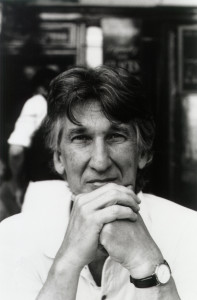
Charles Mee has written Big Love and True Love and First Love, bobrauschenbergamerica and Hotel Cassiopeia, Orestes 2.0 and Trojan Women A Love Story, and Summertime and Wintertime among other plays–all of them available on the internet at www.charlesmee.org, and, as a free Iphone app at the Iphone app store. His plays have been performed at the Brooklyn Academy of Music, American Repertory Theatre, New York Theatre Workshop, the Public Theatre, Lincoln Center, the Humana Festival, Steppenwolf, and other places in the United States as well as in Berlin, Paris, Amsterdam, London, Brussels, Vienna, Istanbul and elsewhere.

He was honored with a full season of his plays at the Signature Theatre. Among other awards, he is the recipient of the gold medal for lifetime achievement in drama from the American Academy of Arts and Letters, two Obies, of a Laura Pels Award, the Booth Award, and of the Richard B. Fisher Award.

He is also the author of a number of books of history (Meeting at Potsdam, The Marshall Plan, The End of Order) that have been selections of the Book of the Month Club and the History Book Club. He is the former editor-in-chief of Horizon magazine, a magazine of history, art, literature, and the fine arts. And he is a lifetime trustee of the Washington think tank, The Urban Institute.

His work is made possible by the support of Jeanne Donovan Fisher and Richard B. Fisher.

25 Jahre Mauerfall or: How I Learned To Stop Worrying and Love the Ossis/Wessis

November 9, 2014 marks a quarter of a century, twenty-five years since the Berlin Wall came down, bringing with it the end of the Cold War, a new era of late capitalism and the reunification of both Germany and Berlin.

English Theatre Berlin | International Performing Arts Center will dedicate the second  half of its 2014 season to examining the events of November 9, 1989 and everything after using the US playwright Charles Mee’s Berlin Circle, a play that takes place on November 9, 1989, as our point of departure.

Charles Mee has made a name for himself in the United States for the last three decades as a proponent of collage-based writing, incorporating texts from a wide variety of sources into his own. Accordingly, Mee offers all of his work for free on his website, providing that those work with his texts the same way he works with the text of others, as a starting point for something completely new.

In this spirit, we have commissioned two of Berlin’s most exciting international freie Szene groups, Sisyphos, der Flugelefant (SdF) and copy & waste, to devise brand-new, site-specific performance pieces as a response to Mee’s play, which, in turn, was influenced heavily by The Chalk Circle (Huilan ji), a Chinese zaju play by Li Qianfu written in the Yuan Dynasty (1271-1368), that inspired Klabund and later Brecht.

The project begins with The Berlin Circle Audio Walk, a performance tour in August in collaboration with the B_Tour Festival, the international art festival of guided tours. ETB | IPAC’s Producing Artistic Director, Daniel Brunet, will offer a guided tour of three of the real locations of Mee’s Berlin Circle, the Berliner Ensemble, Checkpoint Charlie and the Pergamon Museum. In addition to ruminations on the past, present and future of these places in the Hauptstadt, each stop on the tour will feature dialog from the play in the form of recorded binaural audio.

The Berlin Circle Audio Walk will also be offered before the respective premieres of We Are the Play by Sisyphos, der Flugelefant (SdF) and Nasty Peace by copy & waste, along with a scenic presentation Mee’s complete urtext, Berlin Circle, at ETB | IPAC.

And before that, you can read the entire play for yourself right here!

Charles_L_Mee

Charles Mee has written Big Love and True Love and First Love, bobrauschenbergamerica and Hotel Cassiopeia, Orestes 2.0 and Trojan Women A Love Story, and Summertime and Wintertime among other plays–all of them available on the internet at www.charlesmee.org, and, as a free iPhone app at the iPhone app store. He was honored with a full season of his plays at the Signature Theatre. Among other awards, he is the recipient of the gold medal for lifetime achievement in drama from the American Academy of Arts and Letters, and of the Richard B. Fisher Award. He is also the author of a number of books of history, and the former Editor-in-Chief of Horizon magazine, a magazine of history, art, literature, and the fine arts. His work is made possible by the support of Richard B. Fisher and Jeanne Donovan Fisher.

Dates

August 9 and 10 | The Berlin Circle Audio Walk – Performance tour of the real locations of Charles Mee’s Berlin Circle as part of the B_Tour Festival

August 28 and 29 | Scenic presentation of Berlin Circle at English Theatre Berlin | International Performing Arts Center

September 6 | The Berlin Circle Audio Walk – Performance tour of the real locations of Charles Mee’s Berlin Circle

September 11 – 14 | September 18 – 21 | September 25 – 29: We Are the Play, an interactive performance by Sisyphos, der Flugelefant (SdF) at Gedenkstätte Berliner Mauer/Berlin Wall Memorial

November 8 | The Berlin Circle Audio Walk – Performance tour of the real locations of Charles Mee’s Berlin Circle

November 14 and 15 | Scenic presentation of Berlin Circle at English Theatre Berlin | International Performing Arts Center

November 20 – 23 | November 27 – 30 | December 4 – 6: Nasty Peace, a production by copy & waste, in and around Kottbusser Tor

Lateralized Readiness Potential – An Investigation of the Immediate

This performance problematizes the normative spatial and kinespheric relationships between the musician and the dancer. Simon Rose (saxophone) and Andrew Wass (dance) investigate the consequences of flattening the hierarchy of the spatial and kinetic operations that govern their relative practices. What is revealed when the musician and dancer have equal access to spacing, level, and facing?

A second investigative trajectory of their performance is to simultaneously discern the compositional limitations and recognize the freedom suggested by the immediacy of the moment. As the sonic and corporeal palettes reveal themselves, an infinite number of ways of manipulating those palettes is also revealed. By limiting their performance to the immediate and not referencing anything outside the performance space, they do not impose any allusions or illustrative restrictions upon the observers. The observers are freed from expectations of meaning and able to craft their own reception of the events on stage.

By experimenting with aleatoric processes, Andrew Wass finds that movement reveals an inherent awkwardness, a humor that echoes our own vulnerabilities. He formalizes the coincidental and emphasizes the conscious processes of composition that are the generative source of much of his works. Influenced heavily by his undergraduate studies of biochemistry at U.C. San Diego, Andrew works by creating a defined, almost crystalline palette in order to generate a myriad of possibilities. The possibilities are reduced and concentrated in the moments of execution and reception. The Judson Dance Theater artists Deborah Hay and Steve Paxton have had a deep impact on him as a choreographer and dancer. Hay’s use of detailed spatial choreographic scores has influenced how Wass negotiates space performatively and choreographically on stage. Paxton’s development of the dynamic weight sharing modality of contact improvisation has shaped how Wass moves and engages with other dancers. The majority of the performance pieces that he has created involve a score that governs the spatial and/or the corporeal choices of the dancers. He has performed in work by Nancy Stark Smith, Mary Overlie, Jess Curtis, Nina Martin, among others. He has taught at festivals and universities in Japan, Germany, and throughout the United States. A member of the performance groups Non Fiction and Lower Left, he is a graduate of the MA program of Solo/Dance/Authorship at the Hochschulübergreifendes Zentrum für Tanz in Berlin.

Simon Rose is a musician and researcher from London, UK. A professional saxophonist (baritone and alto), Rose has performed frequently in Europe and North America. He has a commitment to developing practice through improvisation processes has encompassed working with large groups as well as the more usual small groups. Rose has a particular interest in the solo form and has recorded critically acclaimed solo CDs on alto (FMR) and baritone (Not Two). Rose’s PhD thesis: Improvisation, music and learning; an interpretive phenomenological analysis (Glasgow Caledonian University, 2012) interviewed world-leading improvisers in US, Canada, UK and Germany. This was his third research project concerning the potential of improvisation. His extensive teaching experience in drama and music includes schools, colleges and universities, as well as work in special educational needs and “permanently excluded” contexts. His early training in drama led him to work as a professional actor-musician in theater-in-education and he has toured schools, prisons and hospitals. His research interest in interdisciplinary relationships and improvisation processes has developed through his particular experience in music, drama and education.

Every Body

Every Body, a dance performance in experiential anatomy: We all possess a body but for most of us it is not so often that we think about the contents, structure, function, or anatomy of this body (not at least, until something goes wrong or something stops functioning properly…we are not going to go there.) In this performance we bring attention to the body each of us is inhabiting, and invite every body to tune in to the experience of their body. It is a performance of connecting anatomies expressed through dance, sound and words.

Liz Erber is an interdisciplinary artist, performer and teacher who has been creating original works for stage, video and site-specific locations for the past decade. Liz, originally from the USA, has lived in Berlin since 2008. She teaches regularly at K77 Studio in Berlin, as well as at international locations and festivals around Europe and beyond. One of Liz’s primary focuses is embodiment, which she shares with performers and non-performers alike. One of her most recent stage works, a multi-media play, Tip of the Iceberg, was featured in English Theatre Berlin | International Performing Arts Center’s development series, THE LAB. Andrew and Liz have performed together regularly over the past several years in various locations around Berlin, including ETB |IPAC, Sophiensaele, Tanzfabrik, ada Studio and more.  In August last year she was a featured artist/film maker for the online film festival, Dances Made to Order. In addition to the performing arts, Liz has also worked in the fields of publishing, writing and translation, and holds Bachelor’s degrees in chemistry, dance and theater.

Andrew Wass began dancing in college, replacing the chem lab with the dance studio. He has had the opportunity to perform in work by Scott Wells, Jess Curtis, Nina Martin, Shelley Senter and Mary Overlie. His dance films have been shown in film festivals in LA, Minneapolis, Rio de Janeiro, Houston, Berlin and San Francisco. His performance work has been shown in San Diego, LA, San Francisco, Marfa, Tijuana and New York. In the fall of 2007, he was an artist in residence at Djerassi. He also received the Jack Loftis and Vibeke Strand, MD honorary Fellowship and an Izzy nomination for music/soundscore/text in 2007. Influential to his work has been a sentence by Keith Johnstone, “Content lies in the structure…” (Impro page 110).

Expat Markt

The Expat Markt is a weekend-long marketplace & performance installation featuring the goods and services of international visual artists, business owners and performers.


Here are some photos from the 2013 Expat Markt: