The nine-day festival IMPRO 2018: Our Lives (March 17 – 25) is the climax of a two-year international theater project that has brought together actors from all 28 countries of the European Union.
It combines the energy and vitality of improvised theater with the rich biographies and experiences of the actors, who use their own lives as a blueprint for what happens on stage. Together with the audience, the directness and strength of the authentic in combination with the abundance of cultural differences results in extraordinary evenings of theater.
English Theatre Berlin | International Performing Arts Center is the center of IMPRO 2018, featuring the opening performance, three specific impro formats reflecting the lives of seven actors as well as the highlight of the entire Our Lives project: the closing night of the festival with 28 artists, who will meet together on stage that evening for the first and last time.
Dates and descriptions of all performances at ETB | IPAC are below and all shows are in English and start at 8pm!
Saturday, March 17 – Opening Show
It has become a small tradition that we ask the international colleagues to bring short country-specific improv formats for the opening evening and to show them to the other actors as well as the Berlin audience. A colorful, blazing, energetic kick-off of our Our Lives festival with no less than 14 improv artists, and that’s only half of the casts – the other one is playing at the Ratibor Theater at the same time…
Sunday, March 18 and Monday, March 19 – Our Lives: Walls
Political or geographical, linguistic or ideological, visible or invisible, borders are shaping us: each freedom is limited by a borderline. From imagination to concrete reality, we build walls to label our divisions. Our Lives could be told by naming buildings and by demolishing these walls. Our homes, our churches and our schools reside inside those walls. Other walls loom between our countries, our cultures. In between those walls, what are our actual contours?
Cast: Antonia Vulpio (Italy), Heather Urquhart (UK), Julie Doyelle (France), Kaspars Breidaks (Latvia), Malcolm Galea (Malta), Roko Crnić (Croatia), Zsuzsi Várady (Hungary).
Artistic Director: Matthieu Loos (France)
Tuesday, March 20 and Wednesday, March 21 – Our Lives: Places
We spent and spend our lives in places. When we remember our grandparents’ living room, the sound of the ticking clock, the smell of the chocolate cake, and the sunlight through the gap in the curtains will come back to us. Let’s have a guess what the artists from seven European countries could bring us: a muddy mountain path in Slovakia; a quiet intersection in a Spanish village; an old farm on the border of Romania; a hot stone on a Greek beach; a wide, white field in the north of Sweden; a busy ferry on the coast of Estonia; a crammed Späti in Neukölln-Britz. Let’s tell each other about Our Lives.
With Billy Kissa (Greece), Leon Düvel (Germany), Lukáš Tandara (Slovakia), Monica Anastase (Romania), Per Gottfredsson (Sweden), Rahel Otsa (Estonia), Raquel Racionero (Spain).
Artistic Director: Christoph Jungmann (Germany)
Thursday, March 22 and Friday, March 23 – Our Lives: Community
Life in contemporary forms of capitalism is becoming unbearable, and one survival strategy is to develop and protect at all costs small communities that offer us different relations. With art, we cannot and do not aim at causing great social change but we can make room for collective creation, a space where it is possible to survive and even have a good time. Every moment is worth asking the very important human question of “How do we actually want to live together?”. And by doing so, we are finding answers along the way.
Exquisite and daring performers from different cultural, economic and political environments dive into the topic of community: Alenka Marinič (Slovenia), Alexander Mitrev (Bulgaria), Audrius Bruzas (Lithuania), Beatrix Brunschko (Austria), Gilles Delvaulx (Belgium), Hannu Risku (Finland), Mia Møller (Denmark). Artistic Director: Maja Dekleva Lapajne (Slovenia)
Saturday, March 24 – 28 AT 7 PM!!
Actually, we cannot believe it yet – an idea has become a reality. For the first and probably only one time, 28 people will stand together on the stage. All that unites them is that they come from the 28 countries of the EU. It’s so easy to write down, but it’s actually incredible and a special moment in the history of this festival. We guarantee nothing but an exceptional evening of improvisation.
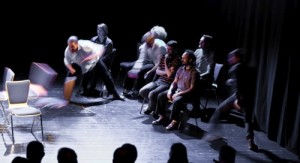
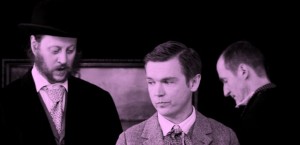 In 2015 as well, Die Gorillas have invited improv artists from 13 different countries to improvise together. The 14th edition of IMPRO will be held from March 13-22, 2015 and once again, we are delighted to serve as one of the festival’s hubs and bring you three different shows, including a very special event: the festival ensemble will improvise the story of a Berlin family from the 1920s to the present over six consecutive nights: The Hoffmanns – A Berlin Family Story. A different year in the family story will be presented each night. 1925 will be followed by 1937, 1955, 1970, 1990 and end in the year 2015. The audience will accompany a Berlin family on a very special journey through time over multiple generations. Even Die Gorillas are excited to see how this improvised family saga will turn out!
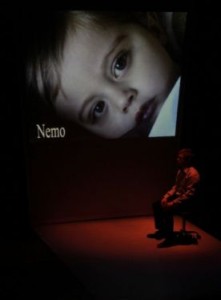 This is the first scripted, non-improvised theater performance that we’ve ever presented during the 14 years of our festival – the focus of this solo is the very international family history of Marko Mayerl of Strasbourg, whose ancestors are from Finland, Germany, Russia and France. A father tells his son who is in hospital the story of their family. It’s an odyssey spanning several European epochs which makes the son forget that he is seriously ill. A Finnish woman marries a Russian, who defies his father’s wish for him to become an orthodox priest. A Frenchwoman, pregnant with her first child, marries a pilot of the German air force while World War II is raging. This autobiographical play, full of tenderness and humor, prompts us to take a look at how we deal with our own family history. Which part of our heritage is acceptable for us to take on, which part do we reject and why?