When women get Gordas, they get thick, heavy, strong, penetrating, troubled and really powerful. Be Gordas!
Gordas is a performance that spins around what’s feminine. From its inception, it was aimed to address the issues of what it means to be a woman personally, socially and professionally.
We are actresses investigating passions, concepts, forms, deformities and intensities. So, what does being a female mean? And what does being an actress mean? In the answers we found different concepts: beautiful, skinny, docile, friendly, crazy, incomprehensible, unbalanced, passionate, erotic, etc.
We address three large chaotic groups as research materials: The chaos inside of ourselves (our personal history, our prejudices, our memories, our pains, etc.), the external chaos (social networks, media, the speed of information, movies, theater, music, dance, images, news, etc.) and the possibility of a chaotic relationship between these two large groups (how to articulate what we are with what happens in the outside world).
We step out of the ordinary, reaching beyond conventional patterns, making every day’s life a theatrical dramatization, an artifice, a metaphor of the battle we fight against the established order. In Gordas, all this information implodes in the body of the actresses and becomes performance. Everything that happens is a performance, everything around us is reality and everything we do is an interpretation.

 Supported by Hauptstadtkulturfonds
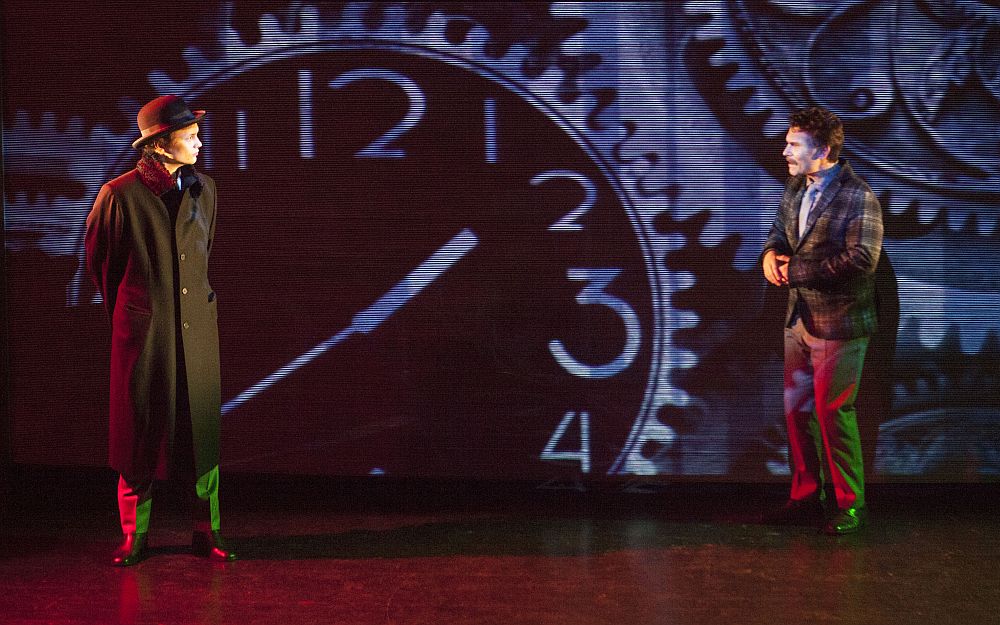 The foundations of European society were being shaken and World War I was about to deal them a final blow when Albert Einstein presented his general theory of relativity in Berlin on November 25, 1915 – now even space, time, gravity and the cosmos were no longer what they used to be. Everything seemed to be relative, all conventions were crumbling and God had left the building.
 Within a few years, Einstein emerged as an internationally-acclaimed scientist comparable to Copernicus or Newton. In Stockholm, however, the Nobel Committee for Physics resisted the massive support for his theories of relativity. What was at stake was whether or not a prize should go to Einstein and his “corrupt Jewish science,” as it was called by those who would soon instigate the next European catastrophe.
 Robert Marc Friedman’s new play tells a tale of strained friendships, the search for new perspectives and scientific integrity against a backdrop of a fierce battle between uncompromising opponents in a decaying society.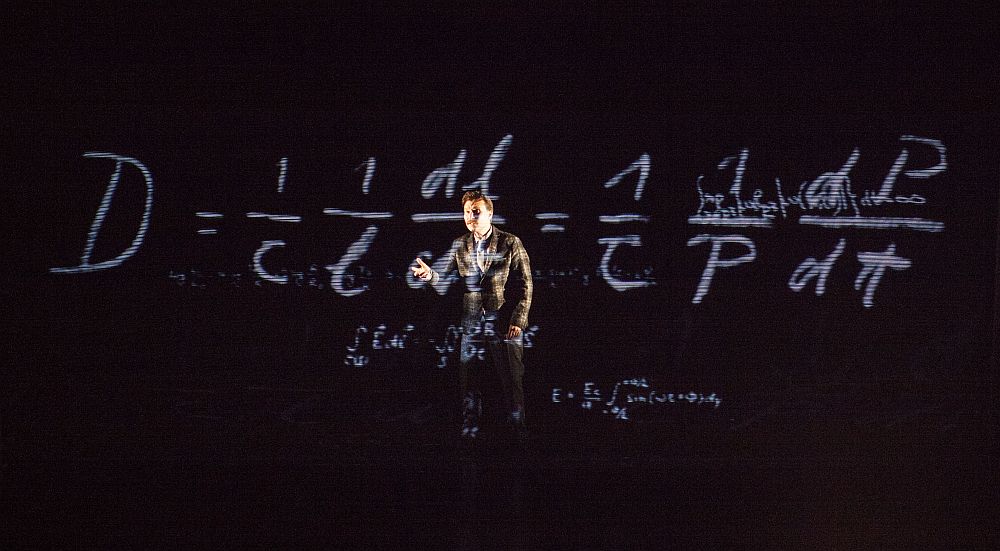
 He doesn´t know a thing about art. But being a former bouncer, Dave gets hired to guard a controversial piece of art. “Jesus on the Cross” is ten feet high by six feet wide and was created in a, well, let’s say, different sort of way. There are people out there who won´t like it, and there are many ways of looking at it. While Dave develops his own relation to art and this particular piece, he begins defending it against his wife, the media and a whole bunch of religious fanatics. Then the shit hits the fan. In the end, his troubles come from an unexpected side.
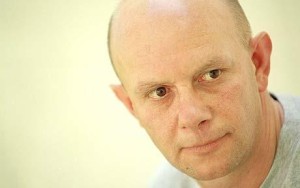 Nick Hornby is an English writer born in 1957 in Surrey. He studied English at Jesus College, Cambridge. His first book, Fever Pitch (1992), was a huge success, followed by High Fidelity (1995) which was made into a film starring John Cusack and a Broadway musical. About a Boy, also adapted into a film starring Hugh Grant, came out in 1998. Hornby´s other novels are How to be Good (2001), A Long Way Down (2005), Slam (2007), Juliet, Naked (2009) and Funny Girl (2014). His short story collection includes Faith (1998), Not a Star (2000) and Otherwise Pandemonium (2005). The film adaptation of Colm Tóibín´s novel Brooklyn for which Hornby wrote the screenplay was released in 2015. He has written numerous essays mostly on music and literature. Nick Hornby received, amongst numerous other awards and prizes, an Oscar nomination for his screenplay for Lone Scherfig´s film An Education (2009). He has been given the name “The maestro of the male confessional” for the brilliant portrayal of his male characters in his novels.
 Within a few years, Einstein emerged as an internationally-acclaimed scientist comparable to Copernicus or Newton. In Stockholm, however, the Nobel Committee for Physics resisted the massive support for his theories of relativity. What was at stake was whether or not a prize should go to Einstein and his “corrupt Jewish science,” as it was called by those who would soon instigate the next European catastrophe.