If you want a better life, you must live a better life.
The performance A Better Life, a co-production from MS Schrittmacher (Berlin) and Brain Store Project (Sofia), deals with the question what a better life can mean and what we do to achieve it.
In European society, moving and being mobile is not only important, but also easier than it was ever before. This gives all European citizens the opportunity to move to a new place if they feel like there can be better options, better living circumstances or sometimes just better weather. We, as individuals, are all responsible to ourselves to live a life that we think is fulfilled and worth living. What would we give up to raise our standards? Are we ready to trade social capital for material capital? What does a good life mean to us and what does even a better life mean to us?
The concept of the performance A Better Life is a result of the research project LUXUS-WEG, funded by the Szenenwechsel (Change of Scene) program of the Robert Bosch Stiftung and a co-production between the performance group MS Schrittmacher from Berlin and ACT Association for Independent Theater from Sofia.
Over the course of this research, the choreographers and performers Martin Stiefermann (Berlin), Iva Sveshtarova and Willy Prager (Sofia) as well as the dramaturg Natalie Baudy (Berlin) have explored the migration patterns of German senior citizens living in old-age poverty going to Bulgaria and young Bulgarians coming to work and study in Germany. The focus lies on the questions of what compromises we make in exchange for a better life and what effects our decisions have on society. What is the motivation for those migration patterns within the EU and what does a better life even mean to us?
To begin, the team met in Sofia where they started their research and made contact with German retirees living in Bulgaria. Afterward, they traveled to Varna, Baltchik, Kavarna and the Golden Beach and talked to female German senior citizens living there about their motivation to start a new life in Bulgaria. They entered into intensive conversation with them, conducted interviews and became acquainted with their living spaces and their everyday lives. In February 2019, a further intensive research phase followed in Berlin, in which a corresponding catalogue of questions was addressed to Bulgarians living in Germany.
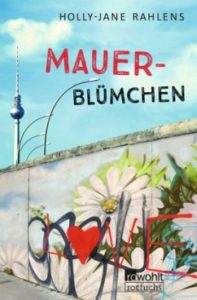 Wallflower is four hours in the life of Molly Lenzfeld, a sixteen-year-old New Yorker in Berlin. It’s Thanksgiving Day 1989, two weeks after the fall of the Wall. Molly, the daughter of a German-Jewish mother who fled the Nazis in 1938, is off to her mother’s birth house in East Berlin. On the train to Prenzlauer Berg, wallflower Molly meets East German wildflower Mick Maier, nineteen. It’s love at first sight. For both, it’s a journey into an unknown land and a world deep below the city’s streets – a fertile terrain in which to discover each other, the absurdities of the divided city, and, of course, the wonder of love.
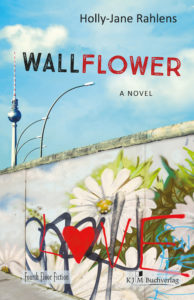 A slew of comic scenes embellished with a great love for detail. — Spiegel Online | Powerful and touching — Berliner Zeitung | … an absolute riot! — Aviva-Berlin | … truly hilarious! — FAZ | Have you ever read a novel that made you feel like you could see the movie version in your mind while you were reading it? That’s what I experienced when I read Wallflower. — Susanne M. Heim »Chicken Soup For the Soul« | A time machine into the past — Deutsche Presse Agentur | A real eye-opener — Politiken