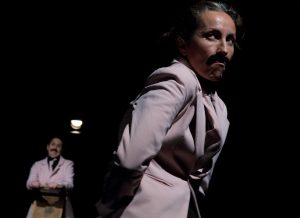
Staged Reading and Panel Discussion
European Drama from Poland and Ukraine
Reading and panel discussion with Olha Mazjupa and Małgorzata Sikorska-Miszczuk
Theater scholar Iwona Uberman and translator Andreas Volk introduce the Polish playwright Małgorzata Sikorska-Miszczuk and the Ukrainian playwright Olha Mazjupa. We will read from their texts Der Schriftsteller (Sikorska-Miszczuk) and Richtung Osten fliegt der Ball (Mazjupa). We will discuss with the authors how a Polish playwright came to write a play about Salman Rushdie in the year 2020 and whether the socially critical comedy by a Ukrainian author might still provoke laughter in 2022. We will also ask the authors why drama from Poland and Ukraine has such a hard time finding its way onto German-language stages.
“For me, Małgorzata Sikorska-Miszczuk is a theatrical free spirit. The protagonists of her plays are often well-known personalities from (contemporary) history, through whom she deals with the great existential questions in an ironic and entertaining way. In doing so, she always succeeds masterfully in maintaining the balance between the seriousness of the content and our grotesque reality,” explains Andreas Volk (translator of Małgorzata Sikorska-Miszczuk).
The statement from the Heidelberger Stückemarkt jury describes Olha Mazjupa as finding “many different scenic styles to make her story shine and to escalate the scenario – small, sharp, gruff dialogues, silent scenes of everyday tasks, surreal images. Olha Mazjupa’s text is what, absurdly, a play must be, an unfinished work of art that cries out for the stage where it is to be finished.”
 Olha Mazjupa, born in 1988 in Pidbirzi near Lviv, is a playwright and theater studies scholar. She studied Serbian language and literature at the Ivan Franko University Lviv and graduated with a PhD from the Marie Curie-Skłodowska University in Lublin in theater and literary studies. Her plays have been performed in Lviv, Chust, Sievierodonetsk and Chernivtsi, and she has worked with theatres in Rzeszów and Sosnowiec. In 2017, her play Öko-Ballade won the internation author prize at the Heidelberger Stückemarkts.
 Małgorzata Sikorska-Miszczuk is a multi-award winning playwright, librettist and scriptwriter in Poland and abroad. She studied journalism and political science at the University of Warsaw. She is also a graduate of the scriptwriting program at the State School for Film, Theater and TV in Łódź. Recipient of scholarships from CEC ArtsLink in the USA, the Adam Mickiewicz Institute and the Stiftung Genshagen. Author of plays that are performed both in the original and in translation, as well as radio plays, opera libretti, film scripts and plays for children. In 2011, she was invited to the Berliner Stückemarkt.
We are very pleased to partner with Drama Panorama to host this event. Please click HERE to read the complete event information on their website.
 NoViolet Bulawayo is the author of the novels Glory and We Need New Names, which was recognized with the Hurston/Wright Legacy Award, the Pen/Hemingway Award, the LA Times Book Prize Art Seidenbaum Award for First Fiction, the Etisalat Prize for Literature, the Fred Brown Literary Award, the Betty Trask Award, the Barnes and Noble Discover Award (second place) and the National Book Foundation “5 Under 35” Fiction Selection. We Need New Names was also shortlisted for the International Literature Award, the Man Booker Prize, and the Guardian First Book Award. NoViolet earned her MFA at Cornell University where she was a recipient of the Truman Capote Fellowship. She has taught fiction writing at Cornell and Stanford Universities. She grew up in Bulawayo, Zimbabwe, and is currently writing full-time from the wherevers.
 Since October 2022, Anne Potjans has been a postdoctoral researcher in the EU-funded research project Tales of the Diasporic Ordinary. Aesthetics, Affects, Archives at Humboldt-Universität zu Berlin, where she currently investigates the relationship between queer subcultural spaces and discourses on race and racism in Germany and the United States. Earlier in 2022, she completed her doctoral degree with a dissertation on “‘Why Are You So Angry?’” – The Uses of Rage and Anger in Black Feminist Literature” in the American Studies program at Humboldt and is a joint winner of Peter Lang’s competition New Perspectives in Black Studies, for which she received a publishing contract with Peter Lang in 2021. Apart from that, she has worked on diasporic connections between African American and Black German feminist autobiographical writing in the post-World War II period and the intersections of Blackness, sexuality, and racial visibility in German film productions. She was an exchange faculty in the Honors program at the University of Washington in the fall of 2019 and has presented and published her research both nationally and internationally.

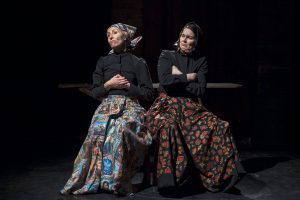 Everywhere they look things are not equal; in the taxi at the end of the night, on the bench in the middle of a village, in the congregation, in the boardroom, in the home. They tell stories of abortion, sing about violence and dance about menopause. They remember the lies they were told as children and question the hope that things might be different for future generations.