etb English
Theatre
Berlin
International Performing Arts Center


Blog Archive

Ay Kash

Eleven girls use their pens, paints and voices to share their memories and experiences since the Taliban took power in 2021 and offer their hopes and dreams for a better future.

Eleven girls
With our hearts full of hope and desire.
With tears in our eyes and trembling legs, with no way to escape.
We are sitting in our bedrooms in Afghanistan and slowly dying.
Every time we rise to show ourselves, our legs are showered with bullets.
Eleven girls who only ask to be allowed to study, to travel, to let our hair fly in the wind and, from all the riches in this world, own a bicycle. Is it too much to ask? Is it too much if I want to become a psychologist? Or a painter?
Too much if I want to fall in love and have my heart broken? Too much if I prefer freedom over longing?
What it my hair turns grey, and my lips are never kissed?
We never wanted our share of the sky to simply be able to gaze at the moon from our bedroom windows.
I want to swim in the sky. Do I want too much?
Eleven brave warriors, standing against the Taliban’s oppression with our pens, art, poetry, and music.
Ay Kash is the voice of a nation sleeping in blood, the voice of a wounded geography.
Don’t let our desire to swim in the sky, rot in our hearts.
Don’t let the desire to take hold of our pen and fight, disappear.
#StandwithAfghanwomen #ThePeninsteadoftheGun
Text: S
Photo: Rhea Schmitt / Design: F

Since the withdrawal of the US in August 2021, the situation for women in Afghanistan has spiralled into despair. Women do not even have rights to be violated. They have lost the ability to learn, graduate, fall in love, travel alone, go for a walk in the park, or ride a bicycle. Ay Kash / ای کاش / If Only is a hybrid performance featuring live on-stage action and filmed “interaction” with eleven young women in Kabul & Herat, Afghanistan. Their true identities will remain hidden because it is simply too dangerous to do otherwise, but what they want to tell you will be given life and poetic space. And they want to tell you many things: they want to tell you the history of their country from their perspective, their personal stories since the Taliban have taken power, the stories of their mothers, their grandmothers and their hopes and dreams for the future. All this and more will burst into life with the help of song, object theater, storytelling and AI. The performance also features animations designed to protect the identities of the eleven young women by Berlin artist Anna Benner. In addition to the live performance, there is a touring exhibition featuring artwork, texts and soundscapes by the young women.

Under the Starry Afghan Sky are eleven young women aged between 15 – 23 living in Kabul & Heart, Afghanistan under Taliban rule. The collective evolved out of the work of Herat Online School founded by the educational activist Angela Ghayour who herself fled Afghanistan in 1992 and is facilitated by Rachel Karafistan of Cosmino Productions.

The Ay Kash / ای کاش / If Only exhibition featuring artwork, soundscapes and audio recorded by the young women from the Under the Starry Sky collective will take place at Graumaleri, Reuterstraße 82, 12053 Berlin from September 7 – 20. (Vernissage: September 7 at 7pm).

The project is entirely funded by public donations. You can donate to our project HERE.


Bowie in Berlin

“Conversations with a Cultural Icon” (II)

In the summer of 1976, pop star David Bowie moves from Los Angeles to Berlin. Why Berlin? Was he attracted by the mixture of Weimar nostalgia, isolated Wall city and niche location for the new music that would later be called Krautrock? In fact, he created radically new music in Berlin in the following two years, recorded both an anthem and a legendary album with `Heroes´, made a curious Weimar-era film with Just a Gigolo, and then disappeared into the pop-synthetic eighties.

“The musical concept of Grosser’s evening works brilliantly …. Just as Bowie’s musical, cinematic and fashionable work has lived from permanent transition and diversity of influence – ready to jump between Krautrock and Expressionism – so is this performance associative and fluid.”     Patrick Wildermann / Tagesspiegel

Great review in Tagesspiegel, read it HERE

In 1987, Bowie returned to Berlin to give a concert in front of the Reichstag, a stone´s throw away from the Wall. East Berliners who came to the Brandenburger Tor to listen started shouting “Bring down the Wall” – the first domino in a series of many that led to the fall of the Wall?
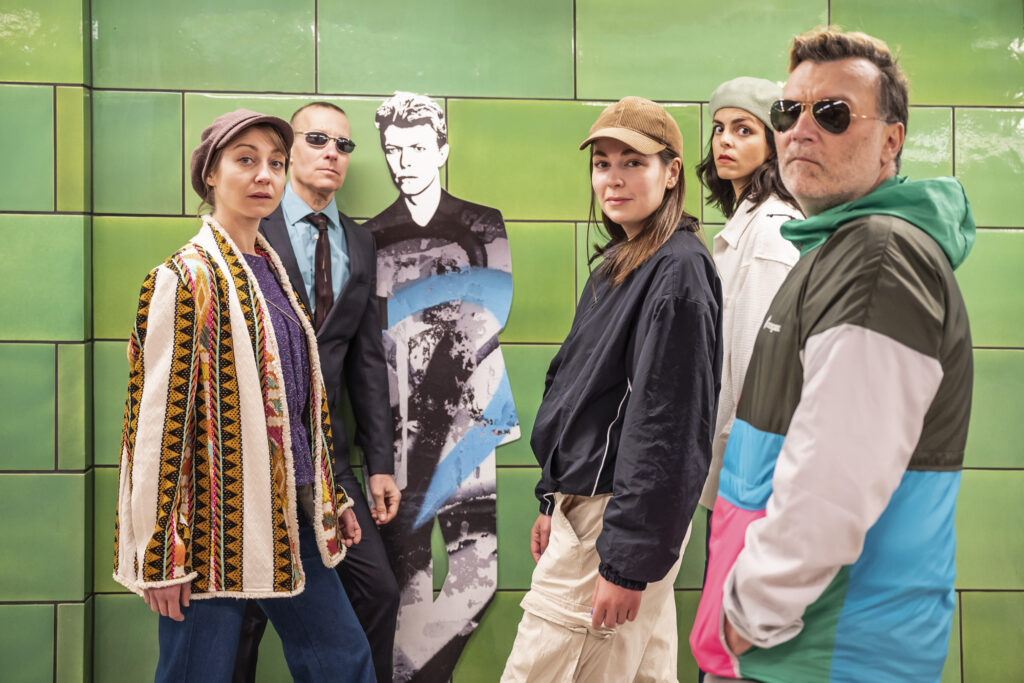
With a performative mixture of music, dance and text, Bowie in Berlin – as the second part of the series “Conversations with a Cultural Icon” after Jaws / Der weiße Hai –  explores the area where pop touches our lives: as music, as film, as art, as an attitude to life.

Today, the three albums of the so-called `Berlin Trilogy´ are considered the artistic highlight of David Bowie´s career.With his creative curiosity, he went through very different artistic phases in the course of his long career, thus appealing to a new audience each time, and ultimately even to a new generation.

Nowadays, David Bowie is no longer just a pop star, but an important artist, to whom renowned museums dedicated a major exhibition ten years ago. Berlin officials even had a plaque placed on his home in Schöneberg.
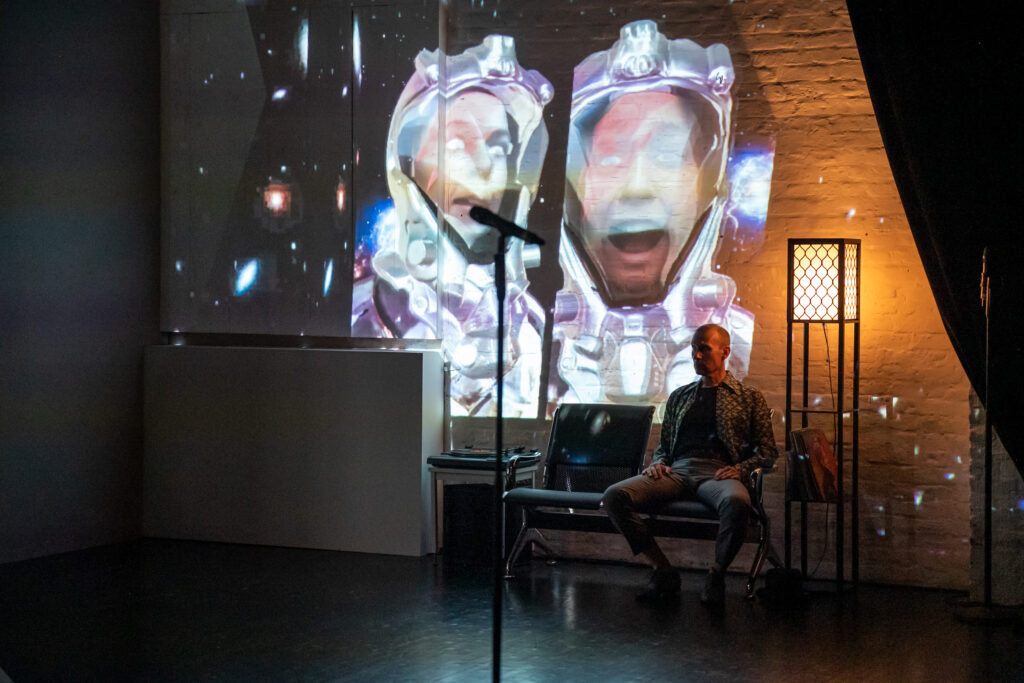
Somehow, Bowie touches everyone. How? What does he have to say? What makes him a pop star, what makes him an artist? And why Berlin?
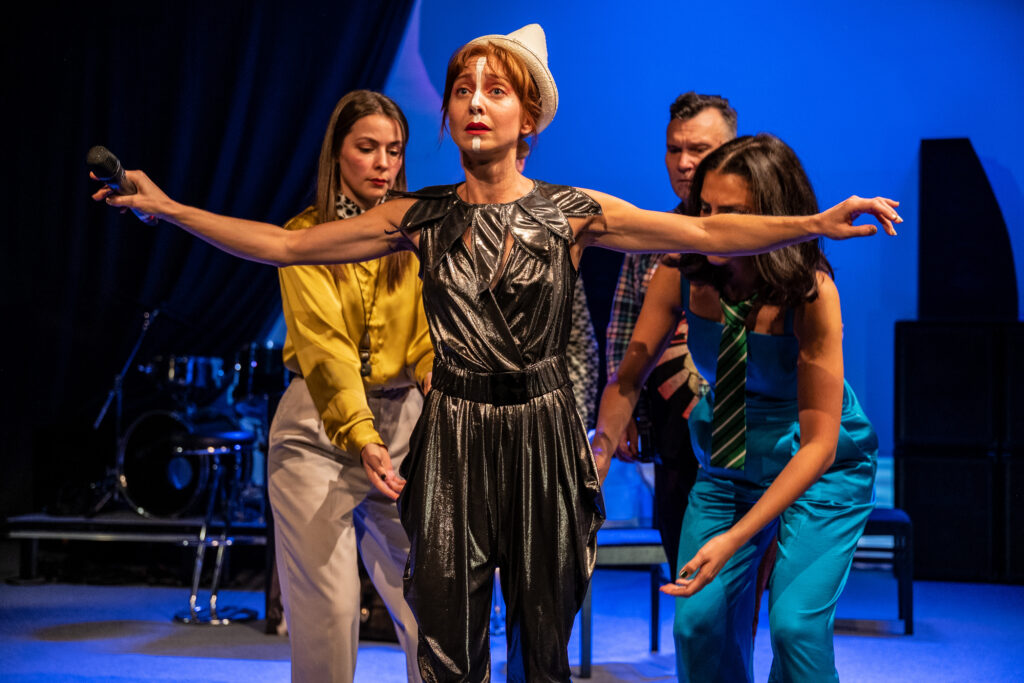
Sales of a Deadman

Only a suitcase remains of our salesman.

This postmodern composition celebrating the sound of everyday objects is inspired by Arthur Miller’s Death of a Salesman and picks up where the play left off: after the suicidal car crash and subsequent funeral, everyone is still out to make money.

This version of purgatory is all about selling, as death has now also become part of the vicious economic cycle. It is now a marketplace where the human being has been transformed into a commodity with their stories, relationships and memories all just waiting to be bought and sold.

Following two sold-out performances in February, we are very pleased to offer two additional performances of this new production and interpretation of the composition Sales of a Deadman by Evan Gardner.

Originally performed in 2014, this new staging features a whole new cast and artistic team, reexamining the role of work-life balance in a post-pandemic, post-patriarchial leaning society, in which capitalism and its place in the marketplace of life is turned on its head and questioned vigorously.

You are currently viewing a placeholder content from YouTube. To access the actual content, click the button below. Please note that doing so will share data with third-party providers.

More Information

Transatlantica

Through an autobiographical reappraisal of choreographer Caroline Alves’ family history, the solo performance Transatlantica delves into the voids between Brazil and Europe, between past and present.

It is one among many family histories that are marked by settler colonialism in Brazil: histories based on the erasure of indigenous ancestors, carrying colonial continuities into the present. Following the traces of Senhorinha, the indigenous great-great-grandmother of whom only the colonial name remains, Caroline Alves explores the violent nexus of patriarchy and colonialism.

Transatlantica interweaves dance and storytelling, atmospherically oscillating between the elements of the stage set: the crystalline cold of a block of ice and the spreading, reflecting water that connects the continents. With tenderness and rage, Caroline Alves confronts her ancestral history and present, searching in the voids of the “official narrative” for the place from which to speak with her own words and movements that may break with the vast silence.

Second Class Queer

Actor and writer Kumar Muniandy questions his identity, queerness, internalized homophobia and experiences of racism with his play. In the midst of these terms and their politics, Kumar seeks his own truth.

Is it possible to live as a brown gay man in Germany and find healing while carrying the weight of oppression from his motherland? Set in a speed-dating event, will Kumar’s leading man, Krishna, win the role he wants in this audition for love?

Through the lens of his experience as a Tamil-Malaysian queer person living in Berlin, Kumar Muniandy has developed a theater piece that investigates the connections between internalized homophobia that stems from anti-homosexuality laws of the colonial era and the structural racism he experiences.

What are the consequences of such merciless neocolonialism for the mental health of queer minorities living in Germany today? After all, Krishna, like Kumar, is on a pursuit of forgiveness and self acceptance.

Second Class Queer is dedicated to Nhaveen.

Following a work-in-progress presentation as part of the 2022 Expo Festival, we are thrilled to offer additional performance of the finished version of this production.

The Berlin Diaries

The great-grandfather of Oregon Book Award-winning playwright Andrea Stolowitz kept a journal for his descendants after escaping to New York City in 1939 as a German Jew.

Following the complicated lure of genealogy, Stolowitz goes back to Berlin to bring the story of her unknown ancestors out of the archives into the light. The record keeps as many secrets as it shares; how do people become verschollen, lost, like library books?

A limited number of free tickets have been reserved for secondary school student groups and their teachers. Please register as soon as possible by email at tickets@etberlin.de

This production is part of the 2023 Berlin Performing Arts Festival, May 31 to June 3, 2023 | paf.berlin


Complete funding for this production and the 2022 performances was generously provided by the U.S. Embassy in Berlin.


These additional performances in 2023 have been made possible thank to the Wiederaufnahmeförderung program of Fonds Darstellende Künste
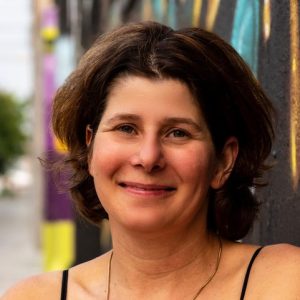


Andrea Stolowitz is a German/American playwright currently living and working in Cork, Ireland. Her work embraces bold theatricality ranging from intimate portrayals of the human condition to the intersection of national history on private lives. Andrea is a member of New Dramatists class of 2026, an alumna of The Playwrights’ Center, and a collaborating writer with the internationally lauded devised theater company Hand2Mouth Theatre. Andrea is the Lacroute Playwright-in-Residence at Artists Repertory Theater. Andrea has taught at Duke University, NYU, UC-San Diego, Willamette University and NUI-Galway.

We Can Do It Moaning (ABA NAIA)

What should we use our mouths for? Just for eating? Shouldn’t we also use them for kissing, licking, sucking and moaning?

Let’s send in these post-porn clowns and see how far you can go as a woman*! But watch out: It gets dirty. It gets messy. It gets hilarious and physical. It remains embarrassing and complicated. ABA NAIA teach us about moaning and transform sounds into language. They challenge the patriarchy with their vocal chords. You are invited to take part in a dialogue at the crossroads of science and lies, comedy and porn, feminism and lust.


You are currently viewing a placeholder content from Vimeo. To access the actual content, click the button below. Please note that doing so will share data with third-party providers.

More Information


The Intervention of Loneliness

“All the lonely people, where do they all come from? All the lonely people, where do they all belong?” – The Beatles

Today we are living in the age of systemic loneliness. Despite the world being more interconnected and globalized than ever before, the number of lonely people continues to grow. Even before the pandemic started, loneliness was already a widespread problem: according to studies, one in ten people living in Germany felt lonely frequently or all the time. The pandemic has only made it worse. Social media, technology, capitalism, hedonistic consumer culture, neoliberal work ethics and urban way of living are contributing to the rise in loneliness and benefiting from it at the same time. Together they form a system that exposes us to loneliness on a daily basis and on a global scale. It not only affects our personal well-being, but also undermines our sense of collective belonging.

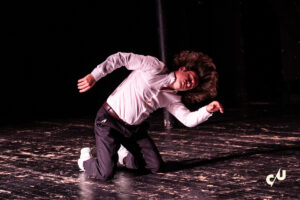
The Intervention of Loneliness is a collaborative dance performance that looks at the issue of systemic loneliness and human disconnection. Developed from an earlier public intervention (Dance With Me) – in which Ming Poon traveled to different cities asking strangers on the street to slow dance with him – this performance invites us to confront systemic loneliness together onstage. Slow dancing becomes an act of resistance, as our bodies reach out, make contact and hold each other. How can we reclaim loneliness, rather than letting it own us? What has the pandemic taught us about it? How can we transform loneliness from a place of separation and isolation into a tool for collective action and solidarity?

Note: A post-performance discussion will be offered after every show.

Ming Poon is a Berlin-based choreographer who began his career as professional dancer in 1993 and started to develop his choreographic practice in 2010. He works with applied choreography and creates choreographic interventions, where spectators are invited to exercise their agency to create change. His works are interactive and collaborative in design. They usually take the form of collaborative performances, public interventions and one-to-one encounters, and involve vulnerability, care, peripherality, queerness and failure as performance strategies. His practice is influenced by Buddhist concept of interdependence and care, Judith Butler’s resistance in vulnerability, Augusto Boal’s theater of the oppressed and Nicolas Bourriaud’s micro-utopias.

He initiated Asian Performing Artists Lab (APAL) in 2020 and is a founding member of United Networks gUG, a non-profit organisation for marginalized BIPoC artists in Germany. He is currently a fellow in the Berlin Artistic Research Program (2022-2023).

His works have been presented at Esplanade – Theatres on the Bay (Singapore), The Substation (Singapore), English Theatre Berlin | International Performing Arts Center (Berlin, Germany), Hebbel am Ufer (Berlin, Germany), Scenario Pubblico | Centro Nazionale di Produzione della Danza (Catania, Italy) and Südpol (Luzern, Switzerland).

Sales of a Deadman

Only a suitcase remains of our salesman.

Our story picks up where Arthur Miller’s Death of a Salesman left off: after the suicidal car crash and subsequent funeral, everyone is still out to make money. This version of purgatory is all about selling, as death has now also become part of the vicious economic cycle. It is now a marketplace where the human being has been transformed into a commodity with their stories, relationships and memories all just waiting to be bought and sold.

This is the world premiere of a new production and interpretation of the composition Sales of a Deadman by Evan Gardner.

Originally performed in 2014, this new staging features a whole new cast and artistic team, reexamining the role of work-life balance in a post-pandemic, post-patriarchial leaning society, in which capitalism and its place in the marketplace of life is turned on its head and questioned vigorously.

You are currently viewing a placeholder content from YouTube. To access the actual content, click the button below. Please note that doing so will share data with third-party providers.

More Information

Learning Feminism From Rwanda

Women in Europe are still fighting for what Rwanda achieved long ago: 62% of their members of parliament are female. In Germany, the figure is just 34%. This East African country declared gender parity the basis of its politics in 1994. Meanwhile in Germany, this kind of parity is still a long way off despite gender equality being enshrined in common law since 1949.

A Rwandan and a German performer discuss numbers and realities from both countries, using a drum as the central symbol of power. They take a peek behind the curtain: if women are empowered, how do men deal with losing their power and what are the lines of confrontation in the home? How slowly or quickly do quotas change a culture and the mindset of a nation?

With speeches, statistics, songs and protest choreography, Learning Feminism from Rwanda follows the trail of Rwandan fast-track feminism from shiny statistics and glass ceilings to hearth and home. Let’s see how much Europe can learn from Rwanda?

Due to the COVID-19 crisis, three performers from Kigali will be present on video and one German and one Rwandan performer will be live on stage.

You are currently viewing a placeholder content from Vimeo. To access the actual content, click the button below. Please note that doing so will share data with third-party providers.

More Information

Die Wiederaufnahme wird gefördert vom Fonds Darstellende Künste aus Mitteln der Beauftragten der Bundesregierung für Kultur und Medien im Rahmen von NEUSTART KULTUR. These additional performances are supported by Fonds Darstellende Künste with funds from the Federal Government Commissioner for Culture and the Media.