etb
English
Theatre
Berlin
International Performing Arts Center
Blog Archive
The Panel
The Panel is a talk show in the form of a staged reading in which five unique personalities engage in a heated, polarizing and humorous discussion about political conditions of the world.
These five guests turn a common and civilized conversation into the most unsuccessful debate in history.
A Flor Da Pele
In Brazil, people say they are à flor da pele (at the flower of the skin or inflorescent skin) when they find their emotions overcoming their reason, just like sweat involuntarily blossoms through the pores of the skin.
It is a moment of excitement, fear, anxiety and physical effort, a moment guided by our non-rational knowledge and deepest desires, our anger and our erotica.
You are currently viewing a placeholder content from Vimeo. To access the actual content, click the button below. Please note that doing so will share data with third-party providers.
Second Class Queer
Actor and writer Kumar Muniandy questions his identity, queerness, internalized homophobia and experiences of racism with his play. In the midst of these terms and their politics, Kumar seeks his own truth.
Is it possible to live as a brown gay man in Germany and find healing while carrying the weight of oppression from his motherland? Set in a speed-dating event, will Kumar’s leading man, Krishna, win the role he wants in this audition for love?
Through the lens of his experience as a Tamil-Malaysian queer person living in Berlin, Kumar Muniandy is developing a theater piece that investigates the connections between internalized homophobia that stems from anti-homosexuality laws of the colonial era and the structural racism he experiences.
What are the consequences of such merciless neocolonialism for the mental health of queer minorities living in Germany today? After all, Krishna, like Kumar, is on a pursuit of forgiveness and self acceptance.
Second Class Queer is dedicated to Nhaveen.
The Theory of Waiting
by Berlin International Youth Theatre
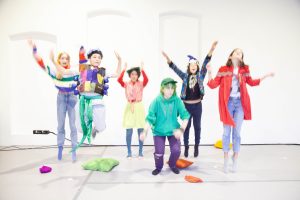
 Loosely based on Samuel Beckett´s Waiting for Godot and inspired by the deep frustrations experienced in the time of the pandemic, BIYT presents an investigation into the perplexing questions that will just not go away.
You know the story, two friends wait endlessly for something. They try to do things right. They really do. But it´s just taking too darn long and soon trouble arrives offering a welcome distraction. We have all been there…
The Shit Show
Anali Goldberg is the most notable thing to come out of the pastoral village of Anal Heights since the discovery of their local delicacy, the dingleberry.
Now Anali is in Berlin and wants to celebrate spring but can’t because the world stinks. She doesn’t have any money, there are shitty images on the streets and shitty songs in her head. The shit is hitting the fan on a daily basis. In between one shit storm and the next, Anali wants to get some fresh mountain air and is planning her trip to Dreckloch in the Alps. But before she can do that, she has to get her shit together and earn some cash to pay off her debts in the neighborhood like the good old days before individual toilet stalls were invented.
You can look forward to an evening full of real old shit watching some really shitty performers give their all and do what they like doing most…while wearing some shitty costumes with some shitty lighting and a shitty host.
S.O.A.R. Study of a Rice Queen
THE LAB: the very first public presentation of work-in-progress by Ming Poon, in collaboration with the Berliner Förderprogramm Künstlerische Forschung (2022-2023).
“This is part of my ongoing artistic research on developing performance strategies to decolonize my body and its representation as an Asian person within the European hegemony. In S.O.A.R. Queen, I turn my research focus on my queer Asian body. Western queer culture and theory are overwhelmingly used as the point of reference in mainstream discourse and understanding of queerness, whitewashing the queer expressions of other cultures. I see this as a form of cultural colonization. As an expansionist project, colonialism is as much about occupying foreign territories, as it is about appropriating culturally-othered bodies and erasing their cultural contexts, histories and knowledge.
In this research, my aim is to develop performance strategies to decolonize queerness through the use of drag as a tool to challenge and de-center the hegemonic west-centric notion of queerness, as well as, disrupt the heteropatriarchal norms in Chinese culture. The task is to construct conceptual prototypes for a decolonial and anti-patriarchal drag, which takes its central reference from the male-to-female impersonation in Chinese opera called Nan Dan (男旦).
S.O.A.R. Queen is supported by the Berliner Förderprogramm Künstlerische Forschung (2022-23). Over a period of 2 years, I work with the 3 archetypal female roles that are most celebrated in Chinese opera: 1) the warrior, 2) the lover and 3) the concubine. This first phase of the research is dedicated to the female warrior: Mulan (花木兰).”
– Ming Poon
Followed by a post-performance discussion
The Berlin Diaries
The great-grandfather of Oregon Book Award-winning playwright Andrea Stolowitz kept a journal for his descendants after escaping to New York City in 1939 as a German Jew.
Following the complicated lure of genealogy, Stolowitz goes back to Berlin to bring the story of her unknown ancestors out of the archives into the light. The record keeps as many secrets as it shares; how do people become verschollen, lost, like library books?
A limited number of free tickets have been reserved for student groups and their teachers. Please register as soon as possible by email at tickets@etberlin.de

Complete funding for this production has been generously provided by the U.S. Embassy in Berlin.
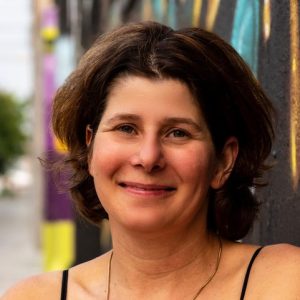 Andrea Stolowitz is a German/American playwright currently living and working in Cork, Ireland. Her work embraces bold theatricality ranging from intimate portrayals of the human condition to the intersection of national history on private lives. Andrea is a member of New Dramatists class of 2026, an alumna of The Playwrights’ Center, and a collaborating writer with the internationally lauded devised theater company Hand2Mouth Theatre. Andrea is the Lacroute Playwright-in-Residence at Artists Repertory Theater. Andrea has taught at Duke University, NYU, UC-San Diego, Willamette University and NUI-Galway.
Back Home
THE LAB: Artist and Audience Development
Rule of Three Collective are together again. For the first time since March 2020.
In the meantime, we’ve spent hours and hours at home; working for money, working out, working out our social lives, working without being paid for it, working on better sleep. How has this time changed our ideas of home? What do we need in order to feel at home? What else can be a home apart from the physical space we live in? And what happens when three performers finally come back to a space they haven’t been to in a while – a theater?
During the residency at ETB | IPAC, Rule of Three Collective will re-embark on an open journey towards notions of home and share some of the findings at the end of the week. Join us back home!
Followed by a post-performance discussion
Parataxe – International Literature
What languages does Berlin write in? In varying locations, PARATAXE regularly invites Berlin authors, who pen their work in languages other than German, to take part in conversations, readings and new translations.
With Aboud Saeed (& his translator Sandra Hetzl) and Avrina Prabala-Joslin!
An evening in German, English and Arabic – with translations. Hosted by Martin Jankowski (Berliner Literarische Aktion).
Aboud Saeed was born in 1983 in a small town near Aleppo, Syria where he worked in a blacksmith’s workshop for 15 years. Then he became an active blogger on Facebook. After his first book, Der klügste Mensch im Facebook mit Statusmeldungen, was published in German translation in 2013, he came to Germany as a Syrian author. He continued writing in Berlin, between asylum and alienation, and his life-sized news ticker, about childhood and youth in Syria, was published. He returned to his first profession as a metalworker in Olafur Eliasson’s studio. His new book Die ganze Geschichte has recently been published.
Sandra Hetzl was born in Munich in 1980 and lives in Beirut. She studied Visual Culture Studies at the Berlin University of the Arts. She works as a literary translator from Arabic and makes video installations. In addition, she is the brain behind 10/11. A laboratory and, simultaneously, a mouthpiece for experimental forms of Arabic literature, 10/11 is based in Beirut and Berlin. The collective consists of writers, translators and international publishing professionals. 10/11 makes texts (often snatched from the depths of the WWW) by young writers working in Arabic accessible to the international publishing market and strives to nurture dynamic exchange.
Avrina Prabala-Joslin writes fiction and poetry on the fluidity of things, place, space and time. She is obsessed with memories, of childhood – they pervade and evade, an ebb and flow characteristic of her desire for the sea. Currently, she is a doctoral researcher at the University of Göttingen and is working on theorizing feminist digital memory. She has an MA in writing from the University of Warwick and has published on a few platforms such as Elsewhere Lit, Bird’s Thumb and Coldnoon. Apart from performing at spoken word events, she posts snippets of poetry on Instagram (@avrinajoslin). Her short story “The Plumage” was shortlisted for the 2019 Berlin Writing Prize. Avrina Prabala-Joslin is currently compiling a collection of feminist short fiction. After having lived in many cities in India, England, Italy and Romania, she recently found home in Berlin.
PARATAXE is a project of the Berliner Literarische Aktion e.V. and is supported by Berlin’s Senate Department for Culture and Europe. Further information can be found at www.stadtsprachen.de.