etb English
Theatre
Berlin
International Performing Arts Center


Blog Archive

The Berlin Diaries

The great-grandfather of Oregon Book Award-winning playwright Andrea Stolowitz kept a journal for his descendants after escaping to New York City in 1939 as a German Jew.

Following the complicated lure of genealogy, Stolowitz goes back to Berlin to bring the story of her unknown ancestors out of the archives into the light. The record keeps as many secrets as it shares; how do people become verschollen, lost, like library books?

A limited number of free tickets have been reserved for secondary school student groups and their teachers. Please register as soon as possible by email at tickets@etberlin.de
This production is part of the 2023 Berlin Performing Arts Festival, May 31 to June 3, 2023 | paf.berlin



Complete funding for this production and the 2022 performances was generously provided by the U.S. Embassy in Berlin.


These additional performances in 2023 have been made possible thank to the Wiederaufnahmeförderung program of Fonds Darstellende Künste



Andrea Stolowitz is a German/American playwright currently living and working in Cork, Ireland. Her work embraces bold theatricality ranging from intimate portrayals of the human condition to the intersection of national history on private lives. Andrea is a member of New Dramatists class of 2026, an alumna of The Playwrights’ Center, and a collaborating writer with the internationally lauded devised theater company Hand2Mouth Theatre. Andrea is the Lacroute Playwright-in-Residence at Artists Repertory Theater. Andrea has taught at Duke University, NYU, UC-San Diego, Willamette University and NUI-Galway.
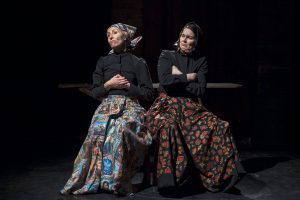
We Can Do It Moaning (ABA NAIA)

What should we use our mouths for? Just for eating? Shouldn’t we also use them for kissing, licking, sucking and moaning?

Let’s send in these post-porn clowns and see how far you can go as a woman*! But watch out: It gets dirty. It gets messy. It gets hilarious and physical. It remains embarrassing and complicated. ABA NAIA teach us about moaning and transform sounds into language. They challenge the patriarchy with their vocal chords. You are invited to take part in a dialogue at the crossroads of science and lies, comedy and porn, feminism and lust.


You are currently viewing a placeholder content from Vimeo. To access the actual content, click the button below. Please note that doing so will share data with third-party providers.

More Information


The Intervention of Loneliness

“All the lonely people, where do they all come from? All the lonely people, where do they all belong?” – The Beatles

Today we are living in the age of systemic loneliness. Despite the world being more interconnected and globalized than ever before, the number of lonely people continues to grow. Even before the pandemic started, loneliness was already a widespread problem: according to studies, one in ten people living in Germany felt lonely frequently or all the time. The pandemic has only made it worse. Social media, technology, capitalism, hedonistic consumer culture, neoliberal work ethics and urban way of living are contributing to the rise in loneliness and benefiting from it at the same time. Together they form a system that exposes us to loneliness on a daily basis and on a global scale. It not only affects our personal well-being, but also undermines our sense of collective belonging.

The Intervention of Loneliness is a collaborative dance performance that looks at the issue of systemic loneliness and human disconnection. Developed from an earlier public intervention (Dance With Me) – in which Ming Poon traveled to different cities asking strangers on the street to slow dance with him – this performance invites us to confront systemic loneliness together onstage. Slow dancing becomes an act of resistance, as our bodies reach out, make contact and hold each other. How can we reclaim loneliness, rather than letting it own us? What has the pandemic taught us about it? How can we transform loneliness from a place of separation and isolation into a tool for collective action and solidarity?

Note: A post-performance discussion will be offered after every show.

Ming Poon is a Berlin-based choreographer who began his career as professional dancer in 1993 and started to develop his choreographic practice in 2010. He works with applied choreography and creates choreographic interventions, where spectators are invited to exercise their agency to create change. His works are interactive and collaborative in design. They usually take the form of collaborative performances, public interventions and one-to-one encounters, and involve vulnerability, care, peripherality, queerness and failure as performance strategies. His practice is influenced by Buddhist concept of interdependence and care, Judith Butler’s resistance in vulnerability, Augusto Boal’s theater of the oppressed and Nicolas Bourriaud’s micro-utopias.

He initiated Asian Performing Artists Lab (APAL) in 2020 and is a founding member of United Networks gUG, a non-profit organisation for marginalized BIPoC artists in Germany. He is currently a fellow in the Berlin Artistic Research Program (2022-2023).

His works have been presented at Esplanade – Theatres on the Bay (Singapore), The Substation (Singapore), English Theatre Berlin | International Performing Arts Center (Berlin, Germany), Hebbel am Ufer (Berlin, Germany), Scenario Pubblico | Centro Nazionale di Produzione della Danza (Catania, Italy) and Südpol (Luzern, Switzerland).

Sales of a Deadman

Only a suitcase remains of our salesman.

Our story picks up where Arthur Miller’s Death of a Salesman left off: after the suicidal car crash and subsequent funeral, everyone is still out to make money. This version of purgatory is all about selling, as death has now also become part of the vicious economic cycle. It is now a marketplace where the human being has been transformed into a commodity with their stories, relationships and memories all just waiting to be bought and sold.

This is the world premiere of a new production and interpretation of the composition Sales of a Deadman by Evan Gardner.

Originally performed in 2014, this new staging features a whole new cast and artistic team, reexamining the role of work-life balance in a post-pandemic, post-patriarchial leaning society, in which capitalism and its place in the marketplace of life is turned on its head and questioned vigorously.

You are currently viewing a placeholder content from YouTube. To access the actual content, click the button below. Please note that doing so will share data with third-party providers.

More Information

Learning Feminism From Rwanda

Women in Europe are still fighting for what Rwanda achieved long ago: 62% of their members of parliament are female. In Germany, the figure is just 34%. This East African country declared gender parity the basis of its politics in 1994. Meanwhile in Germany, this kind of parity is still a long way off despite gender equality being enshrined in common law since 1949.

A Rwandan and a German performer discuss numbers and realities from both countries, using a drum as the central symbol of power. They take a peek behind the curtain: if women are empowered, how do men deal with losing their power and what are the lines of confrontation in the home? How slowly or quickly do quotas change a culture and the mindset of a nation?

With speeches, statistics, songs and protest choreography, Learning Feminism from Rwanda follows the trail of Rwandan fast-track feminism from shiny statistics and glass ceilings to hearth and home. Let’s see how much Europe can learn from Rwanda?

Due to the COVID-19 crisis, three performers from Kigali will be present on video and one German and one Rwandan performer will be live on stage.

You are currently viewing a placeholder content from Vimeo. To access the actual content, click the button below. Please note that doing so will share data with third-party providers.

More Information

Die Wiederaufnahme wird gefördert vom Fonds Darstellende Künste aus Mitteln der Beauftragten der Bundesregierung für Kultur und Medien im Rahmen von NEUSTART KULTUR. These additional performances are supported by Fonds Darstellende Künste with funds from the Federal Government Commissioner for Culture and the Media.

Heartburn

Two women face the truth of the dissolution of the European egalitarian dream.

Everywhere they look things are not equal; in the taxi at the end of the night, on the bench in the middle of a village, in the congregation, in the boardroom, in the home. They tell stories of abortion, sing about violence and dance about menopause. They remember the lies they were told as children and question the hope that things might be different for future generations.
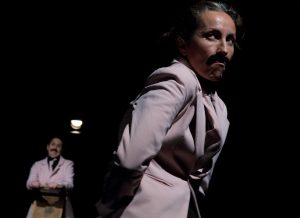
The performance uses puppetry, comedy, song, text and movement to create a hybrid, humorous and powerful perspective on being a woman in Europe today.

“For it was Adam who was first created, and then Eve” – Timothy 2:1

————-> HEARTBURN show trailer

Performed in English, Polish and Spanish with English surtitles

The Workshop

Your Story: A workshop for everyone who has ever identified as a woman – suitable for +15 – led by British visual artist Jo Johnston and the Heartburn cast.

The workshop will be held on Saturday, January 28 from 11:00 am to 2:00 pm. Attendance is free of charge, but you must register in advance by sending an email to info@cosmino.org

After seeing the performance of Heartburn, we invite you to attend a free follow up creative workshop where you will work with members of the artistic team to create “story collages” of your experiences and feelings.

The new works of art created in the in workshop can then be uploaded to our website www.heartburnwomen.com

I Love EU?

A Performative Examination of the EU

Can the European Union be an inspiration for a peaceful postnational world? Is it the non plus ultra expression of what the continent learned from two world wars? Or is it an incredibly strained construct that falls apart at the first signs of a crisis? How does a Eurocentric view differ from that of the increasing number of people forced to leave their homelands and gather at the borders of Europe and the EU in hopes of survival and a dignified existence?

Four performers explore these questions using 50 interviews conducted with EU citizens and non-EU citizens to create an open and interactive evening of theater.

In English and other languages

Salvation (Glitter Doesn’t Care I’m A Boy)

A science fiction drag ritual and an experimental invocation for a constant distribution of desires based on visions and fantasies Shlomi Moto Wagner has experienced since he was three years old.

It explores transformations, mutations and remanifestations of the idea of being, the sensuality of being a body, the politics of having
a body and the poetics of sharing a bodily experience.

This solo music theater piece is a mythological and poetic reading of current pop culture and its academic discourse. The music of ancient
Jewish texts and invocations together with visionary tunes of composer Hildegard von Bingen from the 12th century is newly arranged with pop hits, techno compositions and contemporary feminist texts. All of this makes the opera performance a ritual of transformation.

Shlomi Moto Wagner is Mazy Mazeltov, is Wendy Williams, is Wisława Szymborska, is Fran Drescher, is Hélène Cixous and her Medusa is David Copperfield and Claudia Schiffer IN ONE BODY! And much, much more.

So, what is reality here and what is fiction? In times where a part of society wants to return to the gender roles of the 1950s, or even the 1940s, it is that much more critical to celebrate a festival of the imagination. Let’s make magic. And what comes out at the end? A concert, a drag queen musical, a monologue slam, a magic show, a bar mitzvah or simply a party with the people? Are the props ready? Powder, lipstick and glitter? All right!

Yellow Banana

Let’s take a little vacation right in the middle of Berlin! We’ll leave our cares behind and dive into a new world of the unknown. We are celebrating the two-hundred-and-fifty millionth birthday of the Eurasian Plate with a culinary feast, a very special Janchi. This distinctive atonement ritual between Europe and Asia will be commemorated by none other than the one-of-a-kind, authentic banana (“yellow on the outside, white on the inside”) Olivia Hyunsin Kim!

Jaws / Der weiße Hai

“ConversationS with a Cultural Icon” (I)

Jaws / Der Weisse Hai captures the aura of a turning point in history – the mid 1970s – and transforms the film’s images, its music, its evocative qualities into a long overdue conversation with a cultural icon. By examining the (then) critical content and (dwindling) relevance of Steven Spielberg’s 1975 movie Jaws we’re dancing and performing an entertaining and critical new look at this mega blockbuster (in fact, the first one of the so called “blockbuster era” of Hollywood movies).
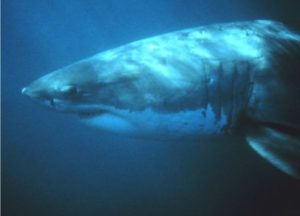
In 1975, the white shark had to serve as a powerful metaphor, and the film’s worldwide mega-success led to decades of demonization of an animal species. But while the sensational success of Spielberg’s film conveys an image of the species Great White Shark that has long been untenable, it also opened up a new view of the relationship between man and animal, a view of the impending ecological catastrophe.

“It gets all psychological: You yell ‘barracuda!’ Everyone’s just ‘Ha?’. You yell ‘shark!!’ We got a panic on our hands on the Fourth of July”

Spielberg’s Jaws is a striking example of a cultural turning point: Just when the so-called counterculture seemed to finally dominate, preparations for a new era began. The names Thatcher, Reagan and Kohl and the economic terms neoliberalism, deregulation and privatization brought traditional values back to the fore and countered the ideas of counterculture. After ten years of youthful optimism, but also mistrust, defeat and fear – Nixon and Watergate; defeat in the Vietnam War, the oil crisis and economic decline – Jaws showed a society banding together in the face of a grave threat, recalling its old values and again producing heroes from its midst.

“We’re gonna need a bigger boat!!”

At the same time, the first voices were raised warning of an ecological catastrophe, of global warming and a major threat to the entire planet. In 1972, the Club of Rome´s famous report, The Limits of Growth, painted an early picture of the disastrous future of planet Earth. Today, overfishing of the oceans and species extinction also threaten the shark populations of our planet – and The Great White is no longer suitable as an animal metaphor for human greed and violence.

Jaws is a movie about a fish, a threat and a hunt. The fish is a giant Great White Shark that appears off a town on the East Coast of the United States. It kills several swimmers and becomes a threat to the summer season of the seaside town, which depends entirely on tourism. An adventurer, a policeman and a scientist pursue the fish in a boat and, after a losing battle, bring it down – the boat sinks, leaving the adventurer and the fish to die.

You are currently viewing a placeholder content from Vimeo. To access the actual content, click the button below. Please note that doing so will share data with third-party providers.

More Information