etb English
Theatre
Berlin
International Performing Arts Center


Blog Archive

King

Fishamble´s KING by Pat Kinevane

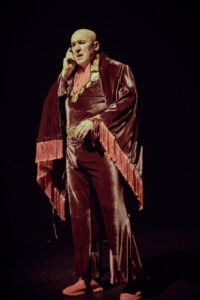
KING tells the story of Luther, a man from Cork named in honour of his Granny Bee Baw’s hero, Dr Martin Luther King Jr. Luther only leaves his apartment for essential journeys, and to perform as an Elvis impersonator. The play explores prejudice, privilege and resilience, as Luther struggles to live life to the full.

PICK OF THE FRINGE, Edinburgh Festival Fringe
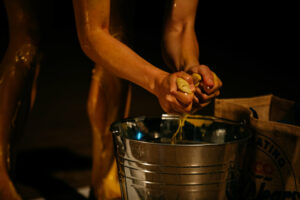
Nominated for the Mental Health Foundation award, Edinburgh Festival Fringe
Nominated Solo Performance at the OffFest Awards, 2024

“incredibly compelling and poignant narrative”  – Irish Times    “the stagecraft [is] unsurpassed…immaculate” – Sunday Independent

“impressive…moments of pure Kinevane gold” – The Arts Review     “virtuosic theatricality…excellent…inventive” – Irish Independent

Pat Kinevane is a native of Cobh, Co. Cork. He has worked as an actor in theater, film, television and radio for 33 years. ​In 2016 Pat won a Laurence Olivier Award in London for his Outstanding Achievement as an Actor and a Writer this year. This prestigious award was shared with Fishamble and Jim Culleton who have been integral to the production and direction of Pat’s four solo shows. As a writer he completed his first full length play The Nun’s Wood in 1997 which won a BBC Stewart Parker Trust Award and was produced by Fishamble. Fishamble then produced his second play The Plains of Enna (Dublin Theatre Festival 1999). Pat wrote The Death of Herod for Mysteries 2000 at the SFX. In 2008 his piece Evangeline Elsewhere premiered in New York in the First Irish Festival.

Pat has been touring since 2006 with his four solo pieces Forgotten (Irish Times Theatre Award Nominee), Silent (Scotsman Fringe First, Herald Angel and Brighton Argus Angel Award), Underneath (Scotsman Fringe First and Adelaide Fringe Awards) and Before (Herald Archangel Award winner) all produced by Fishamble.
Photo: Maurice Gunning | Main Image: Leo Byrne, Publicis

Cascando

Pan Pan’s Cascando by Samuel Beckett

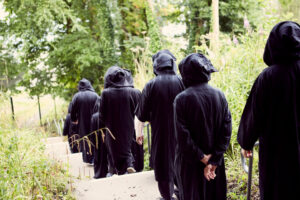
Accompany Samuel Beckett’s curious figures into an uncertain future. Attired in dark cloaks and given headphones, audiences are guided through a rhythmic, immersive, group choreographical experience.

First broadcast in 1963, Cascando begins with the curious character Opener (Daniel Reardon) setting the scene: the month of May, a time of “reawakening”.  The Opener commands two other presences: the winding Voice (Andrew Bennett) caught between arrest (” – stories … if you could finish it …”) and progress (“- nearly … just a few more … a few more”), and Music (designed by Jimmy Eadie), whole and forceful.

Director Gavin Quinn, dramaturg Nicholas Johnson and designer Aedín Cosgrove recognize this as a journey. The audience are sent walking in an outdoor landscape, wearing cloaks and listening to the play on headphones.  The unhurried pace of Bennett’s deep and riveting voice provides a rhythm for our steps, as we listen to Voice’s struggle to tell a story.

The absent figure named Woburn is identified by his “same old coat” and vague memories of a cave or shelter. As the same-dressed audience pass each other in the dark surroundings, it appears that images of the text have been slyly extracted. Has the audience been unknowingly cast as the play’s mystifying wanderer?

Along this journey, the tremendous pulse of Eadie’s music threatens to overwhelm. It rises in a wave of crashing strings, eventually settling to ring, pining, with Voice’s efforts. If you suspected that Woburn’s journey resembled a pilgrimage, Reardon’s sullen Opener somewhat confirms it, suggesting God and a parable: “two outings and a return, to the village, to the inn”.

Pan Pan was founded in 1993 by Co-Artistic Directors Aedín Cosgrove and Gavin Quinn. The company has created 52 new theater and performance pieces and toured worldwide, receiving multiple national and international awards. Pan Pan have toured extensively to prestigious venues and festivals around the world including BAM, Lincoln Center, St Ann’s Warehouse, NCPA China, Edinburgh International Festival Sydney and Melbourne Festivals, the Barbican and HAU Berlin. Since its inception, Pan Pan has constantly examined and challenged the nature of its work and has resisted settling into well-tried formulas. Developing new performance ideas is at the center of the company’s mission. All the works created are original, either through the writing (original plays) or through the totally unique expression of established writings. Pan Pan tries to approach theater as an open form of expression and has developed an individual aesthetic that has grown from making performances in a host of different situations
and conditions.
Photo: Matthew Andrews


Mustard

Fishamble´s Mustard by Eva O’Connor

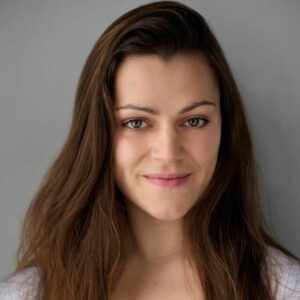
When E meets the man of her dreams, a professional cyclist, love hits her in the pubic bone like a train. But when it ends she plummets into a black hole of heartbreak at the speed of a doped up team on the Tour de France.

​A one-woman show about heartbreak, madness and how condiments are the ultimate coping mechanism, by award-winning playwright & performer Eva O’Connor.

WINNER – Scotsman Fringe First Award 2019
WINNER – Lustrum Award, Edinburgh 2019
​NOMINATED – Scottish Mental Health Awards 2019
WINNER – Critic’s Circle Award, Adelaide Fringe Festival 2023

“Part Fleabag, part Marina Abramovic, it straddles the line between theatre and performance art. Eva O’Connor delivers a fiery performance that never wavers in its intensity… Her writing, too, is strong. The script is densely packed with jokes and rich metaphors and she explores the issue of mental health with sensitivity and aplomb.”
★★★★ Irish Times

“So scarring and funny, so laden with jealousy and hate and wickedness…The stagecraft is starkly simple, the set could be a work of conceptual art, but delicious and shocking to watch, if not to eat…What a privilege to see this …if you want to see a bit of real theatre, go see Mustard.”
★★★★ Scotsman

Eva O’Connor is a writer and performer from Ogonnelloe, County Clare. She studied English and German at Edinburgh University before completing an MA in theater ensemble from Rose Bruford drama school in London. Her plays include My Best Friend Drowned in a Swimming Pool, Kiss Me and You Will See How Important I Am, My Name is Saoirse, Overshadowed, The Friday Night Effect (co-written with Hildegard Ryan), Maz and Bricks and Mustard.


Eva’s runs her own company Sunday’s Child, with Hildegard Ryan. Eva has won various awards for her work including Best Emerging Artist Award, 2012 (Edinburgh Fringe), First Fortnight Award, 2014 (Dublin Fringe), Argus Angel Award, 2015 (Brighton Fringe), Fishamble Award for Best New Writing, 2015, Best Theatre Award, 2017 (Adelaide Fringe), Scotsman Fringe First Award in 2019 (Edinburgh Fringe) and Lustrum Award 2019 (Edinburgh Fringe).
Her play Overshadowed was recently adapted for television by BBC Three and Rollem productions, directed by Hildegard Ryan. It won Best Drama at the Mind Media Award 2019.
Eva has also written for radio. Her play My Name is Saoirse was adapted for radio by RTÉ Radio 1 and Eva’s short story The Midnight Sandwich was recently aired on BBC radio 4.
Photo: Jassy Earl

¡SILENCIO, POR FAVOR!

The idea of absolute silence is both gratifying and threatening.

Silence can be wellness or torture, a coveted resource or an absolute nightmare. But above all, it is an impossibility: “Try as we may to make a silence, we cannot”, John Cage observed after visiting an anechoic chamber and encountering not silence but the buzzing of his nervous system and the throbbing of his blood.

¡SILENCIO, POR FAVOR! initiates a search for perfect silence, knowing full well that it does not exist. Therefore, when the ensemble searches for silence, it is actually searching for sounds: sounds of everyday life, sounds of coincidence, unintended sounds and inaudible sounds that buzz through the space in the form of imperceptible frequencies. Using selected works by John Cage and Cathy van Eck and with the help of the antennae of sound artist Marta Zapparoli, Björnsson | Marx and Opera Lab create a dense mesh of music, sounds and texts, opening up a space for reflection and experience in which the ambivalence of silence is treated just as much as the contingency of our acoustic perceptions.

Supported by


Media partner


Happy Days

Oh this is going to be another happy day!” – Winnie


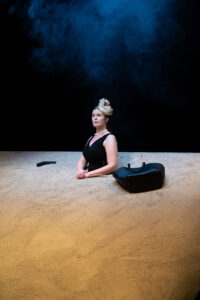
Under a mute sky of blazing light; Winnie, sunk to her waist in a mound of sand, and her husband Willie, mostly immobile in a cave behind her, attempt to cope with their doomed situation.
Winnie, “a bird with oil on her feathers“, as Beckett once described her, is woken by a bell “piercingly sharp like a knife“ that ignites her daily survival routine and quest to engage Willie with every aspect of it. Winnie‘s insatiable need for human connection and Willie’s unwillingness or inability to answer it, contribute to their “nec cum te and nec sine te” / “neither with you nor without you” bond, full of tragicomic moments, culminating in an ambiguous surprise once Winnie is neck-deep in the sand.

Happy Days first premiered in 1961 in New York and has since then unquestionably become a classic of the modern stage. In 2022, The Independent named it one of the 40 best plays of all time. More than six decades later, Beckett’s darkly comic vision of the apocalypse and the banality that comes after remains as timely as the day he wrote it.

Walter Asmus collaborated with Samuel Beckett on numerous theater and television productions from 1974 until the author’s death in 1989. He has directed all of Samuel Beckett’s plays internationally. His 1991 production of Waiting for Godot at Dublin’s Gate Theatre was revived multiple times, toured internationally until as late as 2008 and was accepted by critics and academics alike as “definitive”.

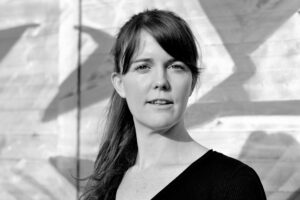
The role of Winnie is played by Berlin-based Irish actor Mary Kelly. Mary has performed extensively in Ireland, including at the Gate Theatre, and in Germany most regularly at English Theatre Berlin | International Performing Arts Center.
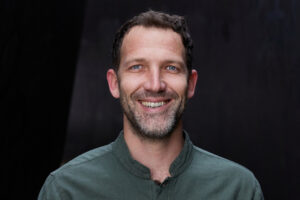
The role of Willie is played by Tomas Spencer, who began his career at ETB | IPAC in the early 2000s and has gone on to appear in numerous films and television programs, including The Last Station, Nymphomaniac and Passport To Freedom.

Photos:  ETB_Maureen Gleason (“Winnie”) / Rosie Condon (Mary Kelly) / Tim Dobrovolny (Tomas Spencer)

Æffective Choreography

How does your body feel today?

In this time of velocity and violence, choreographer and performer André Uerba explores intimacy as a practice of being together, along with seven performers and a musician. This work plays with the boundaries between sharing and withdrawing, movement and stillness, vulnerability and exposure.

The performers structure their encounter through a slow pace, propelling their bodies to attune, sink and merge together, refining their present moment. The desire to make hidden things visible is unfolded by their intimate gestures. Collectively they turn their gaze to inner landscapes where slowness and touch become a main practice.

In English

Please note that this production contains nudity.

Innervoice-Dot-RU

This participatory documentary performance is about the boundaries of personality in terms of dictatorship and repressive state politics.

It is based on the statements of citizens who have remained in Russia, who are against the regime and the war and who continue their resistance from the inside. The audience plays an active role in the performance: using the instructions, they affect the dramaturgy of action to a certain extent. Together with the performer, they create the space for co-existing and togetherness in a collective reflection of how it is to live inside a dictatorship with aggressive internal and external policies.

Girevik

In Girevik, a man embarks on a physical exchange with iron weights.

Responding to the objects’ proposals requires him to push his body to the edge of its physical abilities. The artist travels through a territory defined by obstacles, constantly at the risk of reaching a dead end. Confronted with his vulnerability, he labors to keep the cast-iron bodies moving. Precisely, gently, sincerely, he rearranges the heavy piles again and again. His fragile play interlaces stillness with collapse and order with chaos. The result is a slowly unfolding composition, full of noise, sweat, and tangible tension built through the artist’s physical and emotional effort.

Girevik muscles in on the domain of the traditional “strongman “archetype, and wrestles it to submission. Deconstructed, strength is unburdened of stereotypes. This work explores what is strong, and what strong is, in our nature, and explores the subtleties, revealing emotional, intellectual, and psychological dimensions.

The piece challenges the historically hyper-masculine aura around the kettlebell and seeks an alternative poetics of labor.

Without language

Retina Maneuver

“She′s living in a world and it’s on fire
Filled with catastrophe, but she knows she can fly away”

Retina Maneuver is a solo lecture-performance that theater maker Ping-Hsiang Wang is currently developing. The performance originates from his unexplainable obsession with Alicia Keys’s pop song “Girl On Fire.” Frustration over not remembering where he was when the song was released in 2012 drives him to delve into his digital archives. Ultimately, Wang stumbles upon a photo accidentally uploaded to his Facebook page and finds himself in a military setting, passionately engaged in bayonet drills and shouting the command “kill.”

When “Girl on Fire” is no longer just a chart-topper but a marching tune for soldiers going into battle, he wonders, will these fragile memories be annihilated by the fire of war?


In English